URD 2025
-
1.1History
OVHcloud’s position as the leading European cloud provider traces its roots to its founding in 1999 as an internet hosting company in France. Over the past 26 years, OVHcloud has developed significantly, initially by expanding its infrastructure and growing its presence within Europe, and then by diversifying its cloud offerings and expanding its operations globally.
Key developments
1999
Founding by Octave Klaba as one of Europe’s first internet hosting companies.
2000
First top-level .fr and .be domain accreditations.
2002
Manufacturing of the Company’s own servers begins.
2003
First use of proprietary watercooling technology for servers.
2004
Initial geographical expansion into Poland and Spain.
2005
Opening of first datacenter, in Roubaix, France.
2006
Opening of a datacenter in Germany. Deployment of proprietary fibre optic network.
2008
Expansion of offering to include telecommunications and internet access. Expansion into Italy, Portugal and the United Kingdom. Additional datacenter opened in Roubaix, France.
2009
Continued expansion in Europe, including the Netherlands, Ireland, Finland, Lithuania and the Czech Republic. Launch of 10 Gbps Bare Metal servers.
2010
Expansion into cloud services. Opening of third datacenter in Roubaix, France.
2011
OVH becomes Europe’s No. 1 web hosting service. Fourth datacenter opened in Roubaix, France. Launch of Public Cloud offering.
2012-2015
Expansion outside of Europe, including in the United States and Canada. Opening of three new datacenters in France and one in Beauharnois, Canada.
2016
Opening of additional datacenters in Roubaix, France and Beauharnois, Canada. €250 million in capital raised when KKR and TowerBrook Capital Partners become shareholders.
2017
Acquisition of vCloudAir in the United States, VMware’s cloud offering.
2017-2020
Continued geographical expansion with the opening of datacenters in the United States, the United Kingdom, Germany, Poland, Singapore, Australia, France and Canada.
2018
Adoption of “OVHcloud” as the Group’s new name, emphasising its positioning as a cloud service provider. Michel Paulin is appointed Chief Executive Officer. Opening of office in India.
2019
Introduction of Kubernetes technology into Public Cloud solutions as well as a range of high-performance processing units. OVHcloud receives its Hébergeur de données de santé (HDS) health data hosting security certification.
2020
Acquisition of OpenIO and Exten. OVHcloud becomes a founding member of the GAIA-X initiative.
2021
OVHcloud receives its SecNumCloud security certification.
Initial public offering on 15 October 2021, in Paris.
2022
Acquisition of ForePaaS. OVHcloud reaches more than 80 available IaaS and PaaS solutions.
2023
Opening of new datacenters in France and India. S&P Global ratings awards OVHcloud a score of 71/100, reflecting the Group’s commitment to leading the data revolution for a responsible future.
2024
Launch of the third generation of Advance Bare Metal Servers (ADV-Gen3) using AMD EPYC processors.
2025
Launch of On-Prem Cloud Platform, a ready-to-use on-premises cloud platform.
SecNumCloud qualification for Bare Metal Pod, a Private Cloud solution combining strategic autonomy and enhanced security.
Launch of the Public Cloud 3-AZ solution in the Paris region, offering high resilience for data.
-
1.2The cloud computing market
1.2.1Cloud computing
Cloud computing means providing users with storage, computing and network resources on demand. Cloud resources are located in datacenters that house servers and equipment used to process, store and transmit data. Users of cloud computing services can access stored data and instruct processing units to perform computing functions automatically, without the need for human interaction, minimising the computing and storage capacities needed on their devices (such as personal computers, tablets and mobile phones). Wherever they are located, as long as they have an internet connection, users are able to access IT services through the cloud.
Businesses can establish and operate their own datacenters using internal IT staff, or they can outsource some or all functions to cloud service providers such as OVHcloud. For many businesses, the time and financial investment required makes proprietary cloud computing less attractive than outsourcing, which means paying only for the resources they actually use. Additionally, it can be difficult for businesses that are not specialised in IT services to innovate at the requisite levels in order to ensure that their cloud infrastructure provides them with adequate services and protections, such as data security. Internal IT systems also might not be sufficiently scalable to meet peak-load demands (unless businesses maintain costly excess capacity).
Servers maintained in datacenters can be used for multiple functions, each of which is accessed through a “virtual machine” created on the server. The virtual machines are operated and separated from one another through a software platform known as a “virtualisation stack.” Each virtual machine can have its own operating system that permits users to develop and run applications. Through a function known as a “hypervisor,” the server’s capacity is allocated to the virtual machines in accordance with the demands of users. Furthermore, software applications have been written to be bundled in “containers” that run directly on the operating system of the server itself, coordinated through platforms known as “orchestration” systems, which generally take up less space and can provide better performance than hypervisor-based virtualisation stacks.
The ability to create multiple virtual machines in each server or to deploy container-based systems allows a cloud service provider to allocate its capacity among multiple user groups or customers in a secure manner. Service providers can dedicate a server to a single customer (a “Private Cloud” system), allocating the server’s capacity among user groups authorised by the customer. Alternatively, a server can be shared among multiple customers (a “Public Cloud” system). Private Cloud customers generally pay monthly charges for dedicated capacity, whether or not they use that capacity. Public Cloud customers generally pay for the capacity they actually use.
In order to optimise the cost of cloud services, many businesses are deploying “hybrid cloud” strategies, in which they combine on-premises or outsourced Private Cloud capacity for their most sensitive functions and data, with Public Cloud capacity for their less sensitive needs. Customers are also deploying “multi-cloud” strategies, purchasing cloud services from several providers. To meet the growing demand for hybrid cloud and multi-cloud services, a cloud provider must offer packages that allow the various solutions to function as an integrated whole.
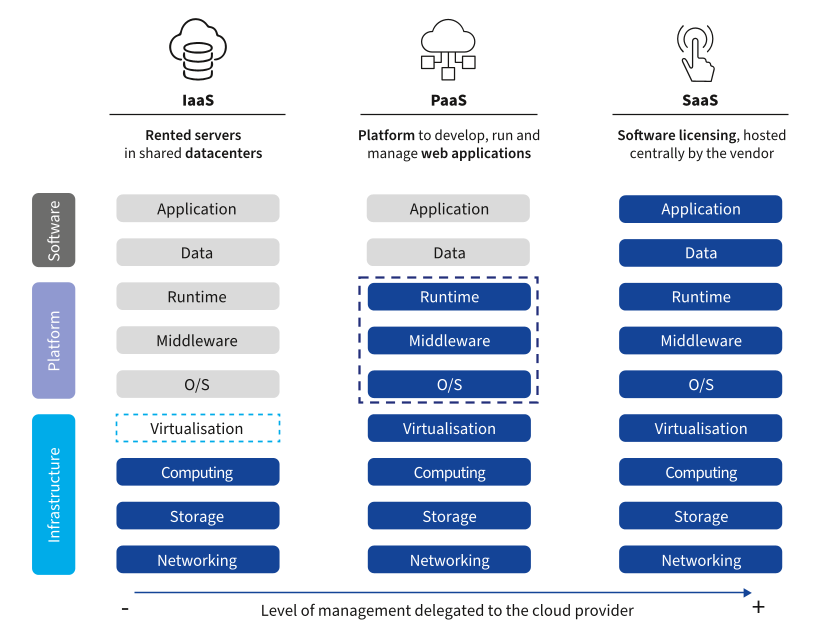
Cloud computing encompasses a range of services that include providing access to infrastructure (Infrastructure-as-a-Service or “IaaS”), selecting and operating platforms such as operating systems, virtualisation stacks and security systems (Platform-as-a-Service or “PaaS”), and offering applications that are developed and can function on cloud platforms (Software-as-a-Service or “SaaS”). These features are illustrated in the following graphic:
The cloud solutions market also includes Web services targeted mainly at individuals and small and medium-sized businesses. The Web Cloud market largely consists of web and domain hosting, including leasing servers for websites, selling secondary services (such as software packages) and domain name registration, renewal and transfer services.
-
1.3Business
1.3.1A comprehensive range of solutions
1.3.1.1Private Cloud
Bare Metal Cloud
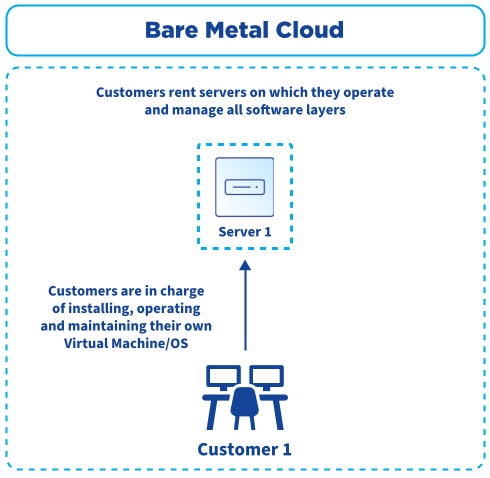
OVHcloud’s Bare Metal Cloud service provides dedicated physical servers to customers, who have full control over the server, including the choice of operating system. The Bare Metal Cloud allows them to have a similar experience to the one they would have with on-premises solutions managed by their internal teams, while taking advantage of the benefits offered by outsourcing.
OVHcloud’s main Bare Metal Cloud offering consists of high-end servers and mid-to-high-level services. OVHcloud also has a lower-priced offering marketed as part of the “Eco” range, which uses refurbished servers that provide quality services at a reduced cost, while improving environmental efficiency.
Bare Metal Cloud services provide business customers with high-level computing power and strict service level agreements in a secure environment appropriate for sensitive data applications. The server can be customised to meet customer requirements and can be operated without allocating the server’s capacity to virtual machines through a hypervisor, allowing the customer to use the server’s full capacity. Any unused capacity can be deployed within minutes, although the total capacity is limited by that of the dedicated server.
Bare Metal Cloud customers pay monthly fees that depend on the performance levels they select. They may also choose options (such as server customisation or data backup) for additional fees.
The main uses of Bare Metal Cloud services include the computation of complex data, low latency operations, streaming, online gaming and critical business applications such as ERP and CRM.
In 2025, OVHcloud launched Bare Metal Pod, a sovereign infrastructure that is SecNumCloud 3.2 certified by ANSSI and dedicated to offering the power of the cloud combined with the physical isolation of Bare Metal servers, designed to host critical or sensitive environments.
Hosted Private Cloud
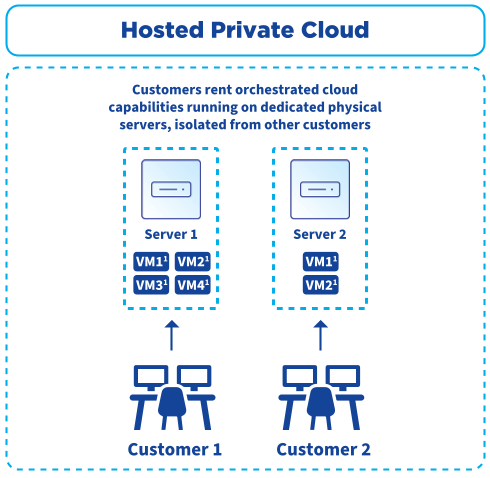
OVHcloud offers Hosted Private Cloud services to its business customers, providing servers fully managed by OVHcloud, including the operating system and the virtualisation layer, in partnership with VMware or Nutanix offerings.
OVHcloud’s Hosted Private Cloud services provide customers with private access to servers that can be customised to satisfy their specific requirements. They meet the needs of customers seeking isolation and security, scalable resources and resilience.
The main uses for Hosted Private Cloud services include deployment in hybrid cloud strategies, media encoding, big data analytics and disaster recovery, as well as the storage and processing of sensitive data in key sectors such as healthcare, finance and the public sector.
Since 2021, OVHcloud has been offering SecNumCloud-certified Hosted Private Cloud services. SecNumCloud certification gives customers the assurance of choosing solutions that comply with the highest ANSSI security standards, as well as the guarantee of having solutions tailored to the sensitive data of public authorities and businesses.
On-Prem Cloud Platform
In 2025, OVHcloud launched On-Prem Cloud Platform, a ready-to-use on-premises cloud platform. The launch was marked by the signing of a commercial contract with DEEP. On 31 March 2025, DEEP, part of POST Group, the leader in telecoms and ICT, postal and postal financial services in Luxembourg, and OVHcloud signed a strategic partnership to develop a sovereign cloud in Luxembourg. The DEEP Sovereign Cloud will be based on OVHcloud's On-Prem Cloud Platform (OPCP): an integrated cloud platform (hardware and software), which will be hosted and operated autonomously by DEEP in its own Tier IV certified data centres in Luxembourg, in an offline mode.
1.3.1.2Public Cloud
OVHcloud offers Public Cloud solutions based on open source technologies such as OpenStack (a platform for deploying processing, storage and networking resources) and Kubernetes (a container orchestration platform that has become a market benchmark). The use of these standard platforms provides customers with easy data transfer capability and deliberately transparent access to source code, facilitating reversibility and eliminating “vendor lock-in”. This feature of the OVHcloud offering is particularly attractive for customers looking to deploy multi-cloud strategies.
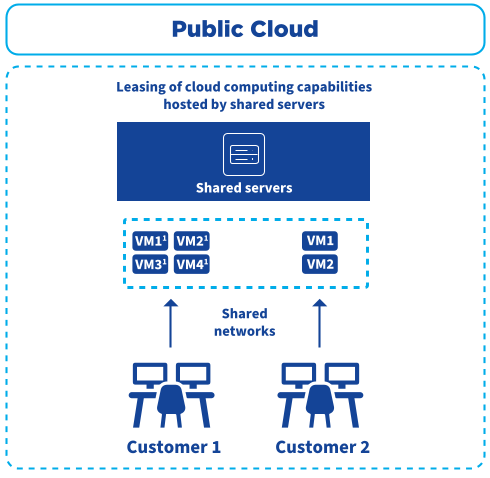
Public Cloud solutions provide users with virtually unlimited computing capacity, with the only constraint being the demands of other users and the total installed capacity of the cloud provider. It is possible to deploy new Public Cloud instances automatically and in seconds. As the Public Cloud service is based on shared servers, customisation options are defined by OVHcloud. The flexibility of the hardware architecture offers high service levels.
Public Cloud customers pay usage fees for the capacity they actually use. The OVHcloud model offers much more predictability than models used by hyperscalers and many other competitors. In particular, unlike hyperscalers, OVHcloud does not charge additional fees for outgoing data transfers or API calls, except for block and archive storage, and for services located in Asia-Pacific.
The Group’s Public Cloud offering provides three core cloud computing services: computer performance, storage and network capabilities.
Customers of OVHcloud’s Public Cloud solutions can choose fully scalable Public Cloud services on virtual machines that are hosted on shared servers and networks.
OVHcloud’s Public Cloud service is attractive for customers seeking highly scalable resources, with significant peak management demands across multiple access locations, and a high degree of resilience. This service is used for applications with high-demand bursts and services that use large volumes of data, such as video and music streaming.
OVHcloud’s Public Cloud customers can also choose from a number of on-demand (SaaS) software running on OVHcloud’s Public Cloud servers. In particular, OVHcloud offers its customers access to Microsoft Exchange messaging and calendar solutions, SharePoint data storage and management solutions, and the Office365 business software suite.
As of this year, OVHcloud offers Public Cloud products in the 3-AZ Paris region. This region offers businesses and organisations a presence in three geographically close datacenters (AZ or Availability Zones) so that they can benefit from high resilience and low latency between the three datacenters.
Virtual private servers
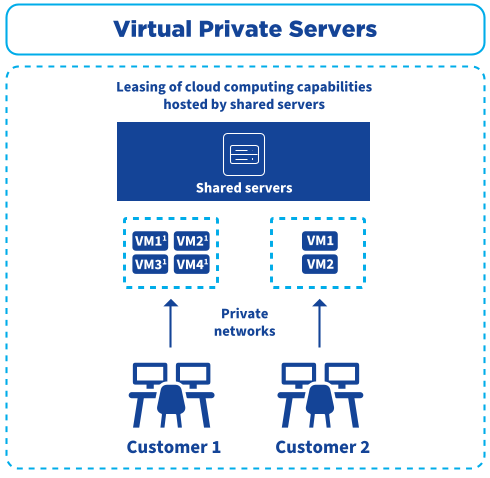
OVHcloud also offers a virtual private server option, providing IT capabilities located on shared servers, but with virtual machines isolated through the use of virtual private networks.
The virtual private server option is attractive to customers seeking tailored resources, particularly for short-term operations with volatile workloads and server demand. Virtual private server solutions are used primarily for applications testing and other one-time projects, the management of short-term peak loads and backup functions.
Platform-as-a-Service (PaaS)
As part of its growth strategy, OVHcloud is developing and implementing a comprehensive PaaS offering, overlaying its Private Cloud and Public Cloud IaaS products. In addition to developing products in-house, OVHcloud has announced several partnerships and acquisitions in order to accelerate its development plan, enabling it to offer more than 80 IaaS and PaaS solutions to its customers by the end of the 2024 financial year, mainly in the following areas:
- ▶Storage. OVHcloud now offers its customers a comprehensive portfolio of storage solutions such as Object Storage S3 (High Performance and Standard), Block Storage, File Storage, Snapshot & Backup and Archive;
- ▶Database-as-a-Service. Data management software allows users to manage their databases to enable queries and updates. It includes programmes that execute queries on data and provide visual representation of the data in formats such as spreadsheets, enabling users to build applications faster and automate database management. OVHcloud announced a partnership with MongoDB in April 2021 and a partnership with Aiven in July 2021 to make several types of database available on the OVHcloud infrastructure;
- ▶AI, Machine Learning & Analytics. Artificial intelligence and analytics solutions include tools and services that support data analysis and presentation. OVHcloud is particularly advanced in high-performance computing solutions for artificial intelligence and machine learning, and intends to continue its development in this area. In April 2022, OVHcloud announced the acquisition of ForePaaS, a company specialising in analytics. Over the last two years, OVHcloud has strengthened its artificial intelligence product offering, including AI Notebook, AI Deploy, AI Training, AI App Builder and AI Endpoint, a platform that uses an application programming interface (API) to provide easy access to numerous pre-trained artificial intelligence models (LLM, voice, image, etc.) for rapid integration into applications;
- ▶Security & Encryption. OVHcloud is expanding its offering of identity access management and encryption solutions, including end-to-end encryption that secures customer data in all states. In July 2021, OVHcloud announced the acquisition of BuyDRM, a US company specialising in this area;
- ▶Application platforms. Application platforms are back-end server software solutions that provide developers with a runtime and development environment.
1.3.1.3Web Cloud and Other
OVHcloud has offered Web Cloud services since its founding in 1999. With its leading position in the French market and strong positions elsewhere in Europe, the Web Cloud offering provides a stable, recurring revenue base and regular growth.
- ▶Web hosting and domain names. This includes the leasing of capacity on servers, allowing customers to connect their websites to the internet, as well as domain name registration, renewal and transfers. Customers can choose basic packages offering just one or a few websites, or packages targeted at professionals and developers that wish to host multiple websites, together with email addresses and storage options. OVHcloud offers its customers additional services, such as Secure Socket Layer (SSL) certificates, which enable secure connections between a web server and a browser;
- ▶Telephony and connectivity. Customers can purchase VoIP (Voice over IP) systems for use as switchboards and interactive voice response systems. OVHcloud also offers customers internet access through ADSL and fibre networks, with basic and professional packages;
- ▶Support and services. OVHcloud offers its customers additional levels of support and services, including a range of support, expertise and online services. There are two levels of support offering: i) Business, which corresponds to the level suitable for production environments, or ii) Enterprise, which offers a key account experience for critical production environments. Additional services are proposed in the Professional Services offering, which provides access to technical support and advice during infrastructure migration or IT architecture changes.
OVHcloud’s main customers in the Web Cloud segment are small and medium-sized businesses, as well as certain individual customers and entrepreneurs. Web Cloud customers generally seek secure and reliable web and communications services to establish their web presence, and to digitise business functions.
-
1.4Strategy and targets
1.4.1A strategy built around four pillars
Since 2021 and its IPO, OVHcloud has been deploying its strategic roadmap. The Group has succeeded in:
- ▶developing key customer segments with average ARPAC(3) growth of 60% between 2021 and 2025;
- ▶addressing a broader market by currently offering customers over 40 Public Cloud products;
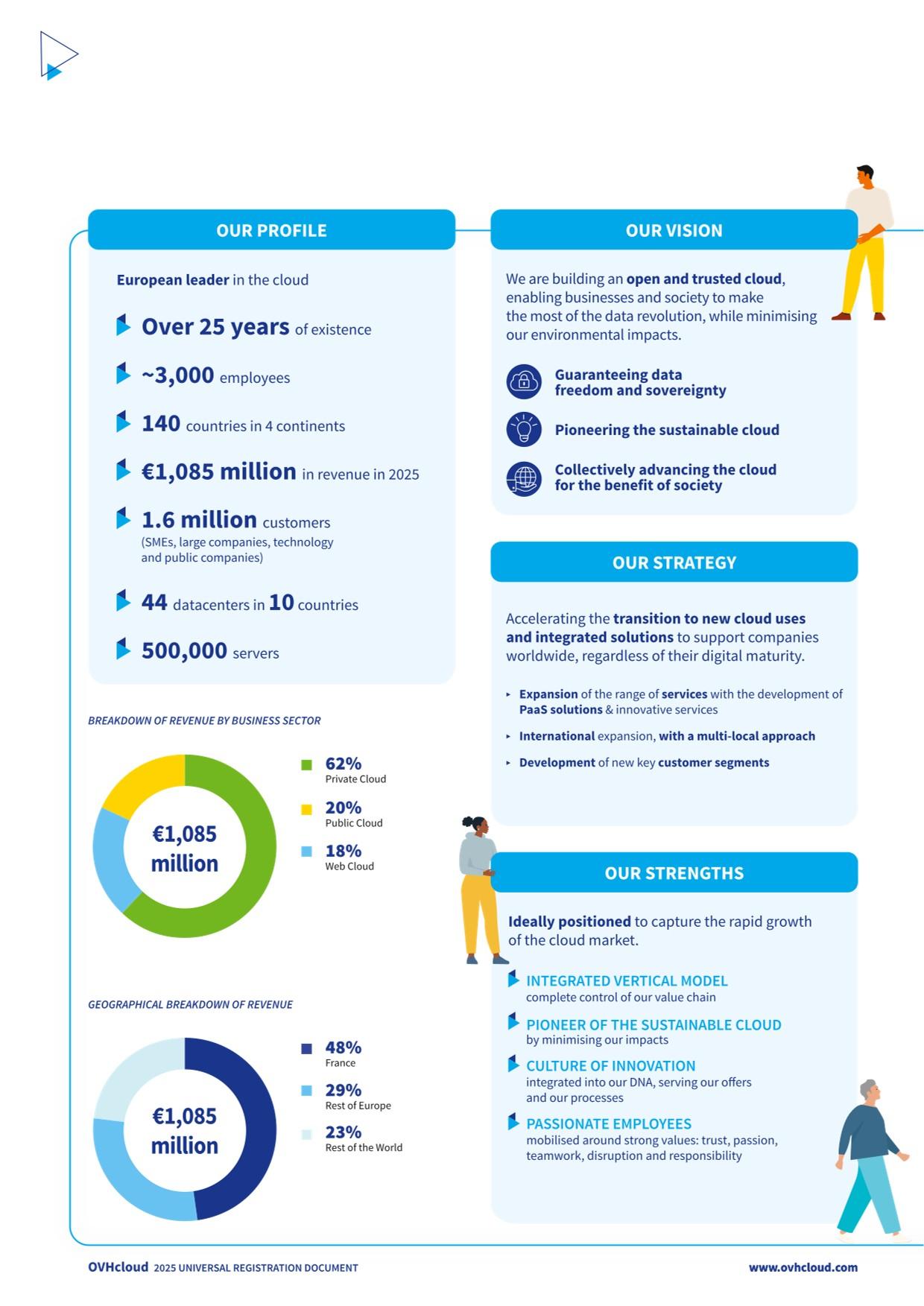
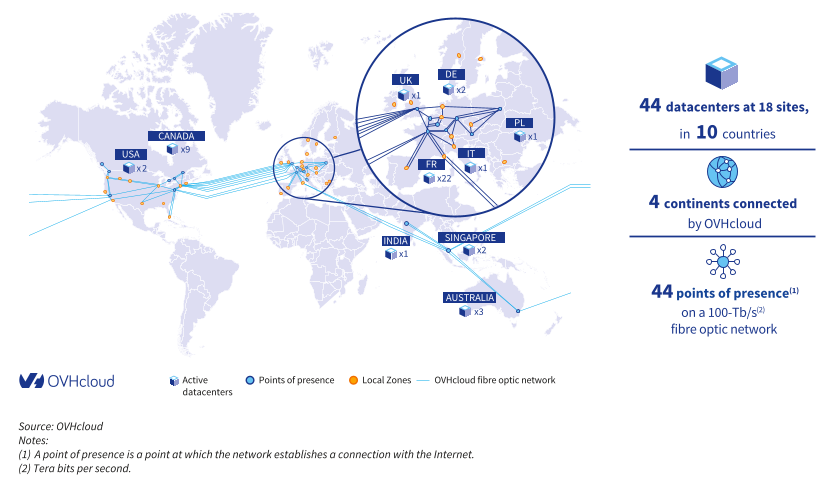
- ▶extending its geographical footprint with the opening of 11 new datacenters since 2021, to reach 44 datacenters by the end of FY2025;
- ▶investing in internal development with cumulative growth capex of around €1,100 million between 2021 and 2025, and external growth opportunities, with three acquisitions since 2021 (BuyDRM in security, ForePaaS in data management, and gridscale, to open Local Zones with minimum capital intensity).
Following these significant investments, OVHcloud introduced a new plan centred around four strategic pillars: (i) Be the data sovereignty reference, (ii) Innovate for next tech revolutions, (iii) Deliver sustainable and profitable growth, and (iv) Maximise cash generation.
Be the data sovereignty reference
OVHcloud already benefits from a structural advantage in that it is not subject to extraterritorial laws, and has developed a successful strategy of certifications with national and international regulators.
In the coming years, the Group will continue to expand its range of certified products, in particular with plans to extend SecNumCloud certification in France to its Public Cloud by end-2025. In addition, this year OVHcloud launched Bare Metal Pod, a sovereign infrastructure that is SecNumCloud 3.2 certified by ANSSI and dedicated to offering the power of the cloud combined with the physical isolation of bare metal servers, designed to host critical or sensitive environments.
In addition, specific services are currently being developed to respond even more precisely to the needs of certain verticals, in particular the public sector and healthcare.
Innovate for next tech revolutions
Innovation is at the heart of OVHcloud’s DNA, and the Group will continue to invest to innovate and prepare for the upcoming technological revolutions, such as artificial intelligence – which is already underway – and quantum computing in the medium term.
With regard to artificial intelligence, OVHcloud is continuing to strengthen its offering, in particular by developing AI solutions that guarantee customer data confidentiality and data sovereignty. OVHcloud offers its customers a broad portfolio of NVIDIA Tensor Core GPUs (H100, A100, L4, L40S) accessible in the Public Cloud and top-of-the line AI models integrating the latest open-source LLMs, like Mistral 8x22B or Llama3, which are notably available on the shelf via the OVHcloud AI Endpoints serverless solution. AI is opening up new opportunities and is at the heart of a revolution, creating extremely high stakes, especially in terms of intellectual property and data confidentiality.
OVHcloud is also ahead of the curve on quantum computing, which will be one of the next technological revolutions of the 21st century. OVHcloud is the only European cloud provider to offer its customers five quantum notebooks and one quantum emulator. The Group supports 14 leading quantum startups and owns one Quandela photonic computer.
Furthermore, in September 2025, OVHcloud became the first global player to strengthen website access security using a quantum computer. In association with Quandela, the Group has introduced quantum entropy-enhanced SSL certificates, improving the random generation of encryption keys.
Deliver sustainable and profitable growth and maximise cash generation
Since 2021, OVHcloud has opened more than eleven new datacenters, invested significantly in the development of new products and set up a programme to improve the resilience of its infrastructure.
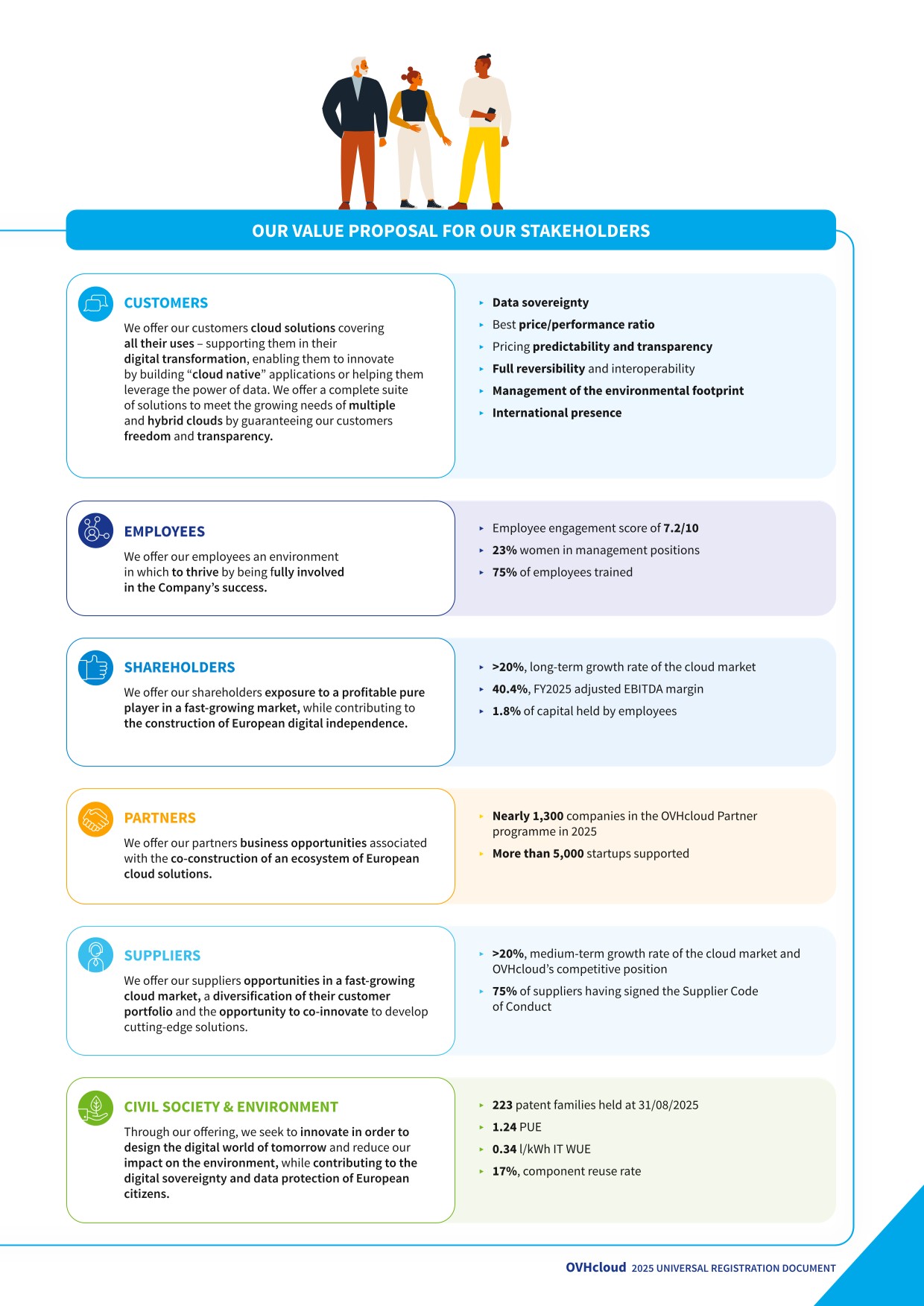
Over the next few years, OVHcloud plans to optimise the utilisation rate of its datacenters, which stood at 66% at 31 August 2025 (up six points compared to 2024), improve inventory management and stabilise investments in new products in absolute value terms.
-
1.5OVHcloud’s competitive advantages
1.5.1Data sovereignty champion with a global presence
OVHcloud is the European Cloud leader and the only non-US or non-Chinese player among the ten largest global cloud service providers(4). It is the only major player of its size that is not subject to extraterritorial laws.
-
1.6Legislative and regulatory environment
1.6.1Legislation and regulations in the European Union
As a French cloud service provider, OVHcloud is subject to European regulations across a wide number of areas, including information technology (“IT”) services, cybersecurity, online content moderation and data protection. OVHcloud may also be subject to sectoral regulatory regimes applicable to certain customers and generally applicable regulations such as contract laws and consumer protection policies.
1.6.1.1Cybersecurity
OVHcloud is subject to European regulations aimed at strengthening cybersecurity across the European Union (the “EU”). Transposed into French law on 26 February 2018, Directive (EU) 2016/1148 of 9 July 2016 established requirements for cloud service providers with respect to network and information systems security. The French law(5) transposing Directive (EU) 2016/1148 classifies cloud service providers as digital service providers. As a digital service provider, OVHcloud must guarantee a level of information security adapted to the relevant risks and adopt appropriate organisational and technical measures. Any security incident having a significant impact on the provision of services must be declared to the French National Cybersecurity Agency (“ANSSI”). The French Prime Minister may also open investigations upon receiving information of non-compliance by the digital service provider with security obligations. Fines for non-compliance with security obligations range from €50,000 to €100,000.
The ANSSI has adopted security standards for cloud service providers(6). In particular, cloud companies must set up a security policy for information relating to the service and carry out a risk assessment covering the entire service. If applicable security standards are met, the ANSSI grants the “SecNumCloud” label certifying an enhanced level of security for the storage of sensitive information. In October 2022, the ANSSI extended OVHcloud’s “SecNumCloud” security visa for its Hosted Private Cloud until December 2023. For the protection of critical information systems, the ANSSI recommends that operators of essential services (e.g., gas supply companies, airline carriers, health institutions, banks) use security products and services with an ANSSI security visa.
The role of the European Union Agency for Cybersecurity (the “ENISA”) was strengthened by Regulation (EU) 2019/881 of 17 April 2019 (the “Cybersecurity Act”). The ENISA is tasked with establishing and maintaining a European-wide cybersecurity certification scheme applicable to cloud service providers, including a comprehensive set of rules, technical requirements, standards and procedures. In July 2020, the ENISA published a proposal that would enable cloud service providers to obtain certifications across the EU attesting to the level of security of their services.
In September 2022, the European Commission unveiled its proposed Cyber Resilience Act (“CRA”). This proposal fixes a series of general and organisational cybersecurity requirements for products containing digital elements (for example: software, hardware products, data processing). It aims to adopt a common base within the European Union to limit cyberattacks. The CRA applies differently to supply chain players: manufacturers, importers and distributors. The text is awaiting examination by the European Parliament and then by the Council of the European Union; during this procedure, which may take up to two years, the current text will most likely undergo certain changes. It is therefore still too early to comment on the impacts this text may have on OVHcloud.
1.6.1.2Data protection
As a provider of cloud and telecommunications services, OVHcloud processes, stores and transmits a substantial amount of personal data. As a result, OVHcloud must comply with a number of European regulations and national laws relating to personal data protection.
European Union – the General Data Protection Regulation (GDPR)
A cornerstone of personal data protection in the European Union since it came into force in May 2018, the GDPR has three main objectives: (i) to establish rules relating to the protection of individuals with regard to the processing of their personal data as well as rules relating to the free movement of such data, (ii) to strengthen the application of the regulation by providing a unified legal framework for organisations processing personal data, and finally (iii) to strengthen the responsibility of parties processing personal data (data controllers and processors) by requiring that processing and the tools/applications used be documented.
The GDPR places organisations under strict obligations in terms of information and transparency with regard to the personal data processing they carry out on their own behalf or on behalf of others.
It also confers a number of rights on data subjects with regard to the processing of their personal data, such as the right of access, the right to rectification and the right to erasure (“right to be forgotten”), giving them greater control over the use of their personal data.
The GDPR also requires organisations to implement appropriate technical and organisational security measures for the processing of personal data as soon as a new product or service is designed, in order to ensure that personal data security and confidentiality requirements are met (“Privacy by design”).
Lastly, the GDPR requires organisations responsible for processing personal data to notify the supervisory authority of any breach that is likely to result in a risk to the rights and freedoms of natural persons and data subjects.
Canada, Province of Quebec – An Act to modernise legislative provisions as regards the protection of personal information
Passed on 22 September 2021, the act to modernise legislative provisions as regards the protection of personal information, known as “Act 25”, makes major changes to the act respecting the protection of personal information in the private sector (“ARPPIPS”), giving citizens greater control over their personal data and making organisations more accountable for the way they manage this information. This act establishes new obligations and transparency rules for Quebec companies, such as the appointment of a Data Protection Officer, in order to establish governance policies and practices regarding personal information, conduct privacy impact assessments (PIAs), and respect the new rights granted to individuals with regard to their personal data, in particular the right to require that such information cease to be disseminated, or that it be re-indexed or de-indexed (the right to be forgotten) before being communicated outside Quebec, and ensure that technological products and services offered to the public have settings that provide the highest level of confidentiality by default.
The new responsibilities and requirements applicable to organisations processing personal data came into force progressively in September 2022, 2023 and 2024.
Compliance tools
In order to ensure compliance with applicable data protection regulations, OVHcloud has implemented a personal data management system based on the ISO 27701 standard.
OVHcloud also relies on the Cloud Infrastructure Service Providers in Europe (CISPE) Code of Conduct, with its certified Bare Metal Cloud and Hosted Private Cloud powered by VMWare offerings, to ensure and demonstrate the compliance of its IaaS activities.
1.6.1.3Free movement of non-personal data
Regulation (EU) 2018/1807 of 14 November 2018 (“Regulation on the free flow of non-personal data”) aims to ensure the free flow of non-personal data between EU Member States (the “Member States”) and IT systems in the EU. Non-personal data is either (i) data not linked to identified or identifiable natural persons, or (ii) anonymised personal data. This regulation enables the storage and processing of non-personal data anywhere in the EU, prohibits data localisation and ensures the availability of data for regulatory control.
The Regulation on the free flow of non-personal data also provides that the European Commission must encourage the development of self-regulatory codes of conduct to facilitate portability between service providers. To that end, OVHcloud participated in the drafting of two voluntary codes of conduct on switching cloud service providers and data portability through the working group on switching cloud providers and porting data (“SWIPO”). Published in July 2020, the codes of conduct for Infrastructure-as-a-Service (IaaS) and Software-as-a-Service (SaaS) provide guidance for cloud service providers and customers on switching cloud provider and porting non-personal data. The adoption of such codes of conduct aims to reduce the risks of vendor lock-in (i.e., situations where customers are dependent on a particular provider due to significant switching costs) by cloud service providers. It also provides guidance for customers on the transfer of non-personal data.
1.6.1.4Online content moderation
As a hosting service provider, OVHcloud must comply with a number of laws on content moderation, including those moderating terrorist content, child sexual abuse material and the infringement of intellectual property rights.
European legislation on digital services (Digital Services Act, “DSA”)
Regulation (EU) 2022/2065 of the European Parliament and of the Council of 19 October 2022 on a Single Market for Digital Services and amending Directive 2000/31/EC (“Digital Services Act”) entered into force on 18 November 2022. This new framework aims to harmonise the rules applicable in the different Member States of the European Union and replaces the framework adopted in 2000 with regard to liability of intermediaries in relation to illegal content while maintaining the fundamental principles of freedom of expression and freedom to provide services.
The regulation also establishes new obligations of due diligence and transparency for hosting services such as OVHcloud, both vis-à-vis the authorities and users, particularly on the processing of reports of illegal content. It also increases the level of penalties that can be imposed in the event of a breach of the obligations established by the regulation, with fines of up to 6% of the intermediary service provider’s global annual revenue. A certain number of measures are applicable on a deferred basis over the next two years and involve the adoption of texts at the national level. OVHcloud will carefully monitor their publication in order to comply with its obligations.
1.6.1.5Fight against anti-competitive practices on digital markets
European legislation on digital markets (Digital Markets Act, “DMA”)
Regulation (EU) 2022/1925 of the European Parliament and of the Council of 14 September 2022 on contestable and fair markets in the digital sector and amending Directives (EU) 2019/1937 and (EU) 2020/1828 (“Digital Markets Act”) aims to make the digital sector fairer and more competitive by introducing preventive measures for large digital companies as gatekeepers on the European market. In particular, the regulation provides for several obligations and prohibitions against gatekeeping online platforms and strengthens the sanctioning powers of the European Commission, which will be assisted by an advisory committee and a high-level group. So, for example, gatekeepers must allow users to easily uninstall pre-installed software on their devices and easily unsubscribe from an essential platform service such as a cloud service. Gatekeepers will no longer be able to impose software such as internet browsers or default search engines or reuse users’ personal data for the purpose of targeted advertising without their explicit consent.
Applicable from 2 May 2023, the companies concerned must report to the European Commission and ensure that they are compliant by March 2024 at the latest. The legislation gives the Commission the exclusive power to monitor compliance with their obligations, and imposes new sanctions, including a fine of up to 10% of the company’s total global revenue from the previous financial year.
The adoption of this new legislation is a positive step towards regulating the practices of the dominant digital players on the European market. However, its effectiveness will depend on the means that the European Commission devotes to ensuring compliance with it. OVHcloud will pay particular attention to the forthcoming details regarding the teams tasked with monitoring gatekeepers' compliance.
1.6.1.6Other applicable regulations and initiatives
Telecommunications sector
OVHcloud entities are telecommunications operators in four (4) Member States: Belgium, France, Germany and Spain. OVHcloud is subject to specific obligations when providing telecommunications services. Because the EU and its Member States have been regulating the telecommunications sector for many years, there are a variety of different implementing measures, guidelines and authorities across the EU. OVHcloud entities are also telecommunications operators in the United Kingdom and Switzerland, which have their own telecommunications regulations. The United Kingdom also implemented the requirements of the European Electronic Communications Code into its national regulatory framework prior to Brexit.
The Directive (EU) 2018/1972 of 11 December 2018 established the European Electronic Communications Code. Although this directive has not yet been transposed in all Member States where OVHcloud acts as an operator, several other directives applicable in the telecommunications sectors, such as Directives 2002/19/EC, 2002/20/EC, 2002/21/EC and 2002/22/EC of the European Parliament and of the Council, have been substantially amended. Directive 2018/1972 was transposed into French law in May 2021(7). The key objective of this European Electronic Communications Code is to create a comprehensive set of updated rules to regulate electronic communications and protect EU citizens when they communicate through traditional or web-based services, encourage competition between telecommunications operators, and ensure that national regulatory authorities are protected against external intervention or political pressure.
Health sector
As a cloud service provider, OVHcloud is subject to obligations when the Group provides services to organisations in the health sector. For example, French law requires health data hosting providers (i.e., any person hosting personal health data collected in the course of prevention, diagnosis, care or social and medical monitoring activities on behalf of natural or legal persons having produced or collected such data or on behalf of the patients themselves) to comply with specific obligations. Such obligations include obtaining proper certification or receiving prior approval from public authorities as per the French Public Health Code, and entering into an agreement with customers in the health sector, setting out the mandatory provisions prescribed by Article L. 1111-8 of the French Public Health Code. OVHcloud is also subject to the requirements of other jurisdictions in which it operates, such as Italy, Poland, Germany and the United Kingdom.
In 2016, OVHcloud obtained the “health data host” accreditation and, since 2018, the Group has operated a management system that allows several of its cloud offerings to comply with the requirements of this accreditation. In 2019, OVHcloud obtained the French HDS (hébergeur de données de santé – health data host) certification for its Hosted Private Cloud offering. In 2020, this certification was first extended to OVHcloud’s dedicated servers and then to OVHcloud’s Public Cloud offering and Trusted Exchange in 2021.
Financial sector
Companies in the financial sector (including credit institutions and investment firms) may also be subject to industry-specific obligations that may reflect on OVHcloud in the context of the provision of its services. In particular, in 2019, the European Banking Authority (“EBA”) issued “Recommendations on outsourcing to cloud service providers” applicable to outsourcing arrangements. These recommendations create obligations with respect to information systems security and audit rights for the outsourcing banks, which they must impose on their cloud service providers when using their services. OVHcloud aims to offer contractual conditions applicable to financial service operators that ensure that customers are able to implement an outsourcing policy which is compliant with the EBA’s recommendations and with local European regulations.
Financial service operators may also require OVHcloud to comply with specific national regulations. For instance, OVHcloud may have to comply with French regulations such as those of France’s banking and insurance supervisor, Autorité de contrôle prudentiel et de résolution (“ACPR”) on critical outsourced services such as banking operations. Companies outsourcing critical services must ensure that service providers guarantee the protection of confidential information, implement backup mechanisms in the event of significant difficulties affecting service continuity and provide the ACPR, in carrying out its duties, with access to critical outsourced information. With respect to internal procedures for managing information system security, the American Institute of Certified Public Accountants (“AICPA”) granted OVHcloud SOC I-II type 2 certifications.
With respect to hosting banking data and reducing card fraud, OVHcloud’s main Hosted Private Cloud offering is compliant with the Payment Card Industry Data Security Standard (“PCI DSS”). OVHcloud’s datacenters in France, Canada, the United Kingdom, Germany and Poland comply with PCI-DSS.
On 27 November 2022, the European Commission adopted a Digital Operational Resilience Act for the Financial Sector (“DORA”). Following a proposal by the 2020 European Commission, this regulation imposes a number of requirements on cloud outsourcing arrangements in the financial sector. The proposed regulation covers a broad range of regulated financial entities, including credit institutions (such as banks), central securities depositaries, insurance companies and certain fund managers, among others. It imposes a number of information and communications technology risk management requirements on these financial entities, some of which apply directly to outsourced cloud activities.
In particular, financial sector entities covered by the proposed regulation are required to take a number of steps to address risks in their relationships with third parties, such as cloud service providers, including ensuring that their cloud services contracts provide a full description of the services proposed with qualitative and quantitative performance targets, and include provisions governing integrity, security, personal data protection, recovery in case of failure, rights of inspection and audit, and termination provisions with clear exit strategies. The regulation proposes the approval of standardised contractual terms by the European Commission.
In addition, the regulation imposes a new oversight framework on critical third-party service providers (including cloud service providers), subjecting them to individual oversight plans adopted by the European financial regulatory bodies responsible for supervising banks, securities markets or insurance companies, depending on the sector primarily using the services of the relevant provider. The determination of which services are critical depends on their potential systemic impact, the dependence of financial entities on them for critical functions and the availability of alternatives. The oversight plan can impose requirements in areas such as security and quality, contractual terms, and subcontracting, with financial penalties imposed in case of non-compliance, up to 1% of the service provider’s global revenue in the most recent year. The oversight bodies have broad inspection and auditing rights and investigative powers. The adopted regulation also prohibits financial entities from using a service provider from a country outside the EU for critical cloud functions.
Environmental and industrial risks
Many of OVHcloud’s datacenters are located in former industrial buildings, some of which are classified as presenting environmental or other risks under applicable French legislation. OVHcloud’s datacenters outside of France may also be classified as presenting environmental risks under local regulations. In order to comply with applicable regulations, OVHcloud is sometimes required to submit applications and obtain operating licenses. OVHcloud may be required to take certain remedial measures as part of the application process.
-
1.7Group organisation
1.7.1Simplified organisational chart
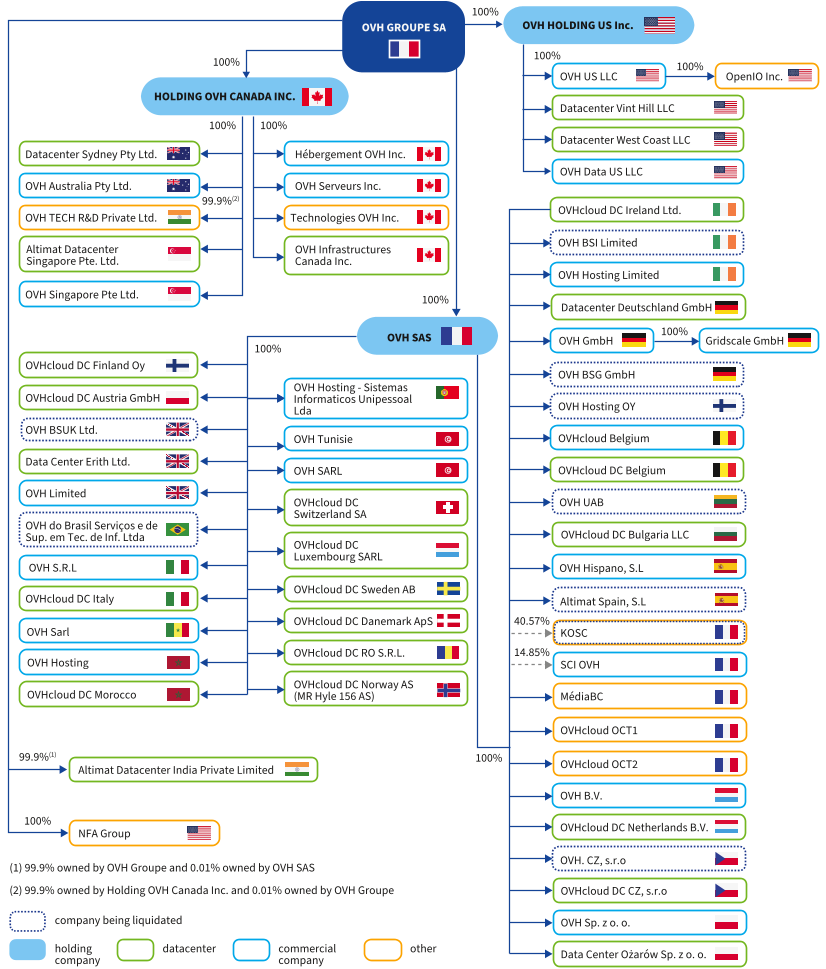
Simplified organisational chart as of the date of this Universal Registration Document
The simplified organisational chart below shows the Company’s legal structure and its consolidated subsidiaries as of the date of this Universal Registration Document. The percentages indicated below represent the percentages of share capital. There has been no significant change in capital ownership since 31 August 2024.
-
Risk factors
and internal controlCentral to its governance mechanism, OVHcloud's risk management system helps the Group achieve its strategic objectives while protecting its assets and reputation. It also helps to mobilise employees around a common approach to risk. OVHcloud is committed to regularly assessing risks and implementing internal controls and action plans to mitigate them.
-
2.1Risk factors /AFR/
2.1.1Risk management system
Risk management system
The risk management system aims to identify, analyse and manage the main risks to which the Group is exposed. It contributes to the control and security of its activities, the effectiveness of its operations and the efficient use of resources.
This system comprises a series of processes aiming to identify, assess and prioritise risks, prevent and control them, promote a risk management culture, and monitor action plans to limit risks. It draws on the skills of the Group's employees, particularly in internal audit and compliance, and on external expertise where required.
CSR risks are covered in Chapter 3 – Sustainability Statement, which includes new CSRD-related requirements, of this Universal Registration Document.
Risk mapping
In 2020, the Group drew up a risk map, which was updated in 2022 and 2023. In 2025, risk mapping was revised with the new Chief Executive Officer, as part of the risk monitoring governance process. Certain risk levels and designations were adjusted.
Carried out across the Group and with the involvement of top management from all the Group's activities, the risk mapping process has made it possible to identify the main risks to which the Group is exposed and to assess their potential impact, taking into account their criticality and probability of occurrence. The Group's risk map also takes into account specific risk mapping exercises on topics such as cybersecurity and anti-corruption, and the monitoring of operational and emerging risks.
The most significant risks have been grouped into different families (strategy and markets, business, human resources, financial, regulatory and legal, information systems). For each risk, a description is provided of their causes and potential impact, as well as the actions taken to manage them.
Risk monitoring governance
Group management, the Board of Directors and the Audit Committee closely monitor risk management and define the most appropriate strategy.
One or more risk owners are appointed for each risk to complete the risk analysis, identify the actions and resources needed to mitigate the risk, and manage the corresponding action plans.
The relevance and progress of the action plans are monitored by members of the Group's Executive Committee, including the Chief Executive Officer, Chief Financial Officer and General Counsel, who review them on a quarterly basis. Risk mapping and action plans are presented annually to the Group's Audit Committee, and more frequently upon request.
-
2.2Insurance and risk coverage
2.2.1Insurance policy
The Group's insurance policy aims to protect its employees, assets, customers and shareholders against the financial consequences of major events.
Its purpose is to ensure business continuity and the operational resilience of the services provided to customers, to reduce the Group's financial exposure in the event of an incident and to strengthen the confidence of all its stakeholders.
- ▶an active prevention and protection policy at its industrial sites, in particular through its “Hyper Resilience” (HYR) prevention plan, designed to protect them against fire risks. The Group has most of its industrial sites audited annually by its brokers' and insurers' prevention engineers;
- ▶awareness-raising sessions on fire risk, with a technical and insurance-based approach, for a wide range of operational staff;
- ▶the development of risk prevention, such as exposure to natural and environmental disasters, therefore enhancing existing insurance coverage.
The insurance policy is part of the Group's overall strategy, taking into account the specific features of its business sector, its growth and its strong international presence.
To ensure that the insurance programme is relevant and appropriate, the Legal Department works constantly to identify risks that could be covered by insurance, in conjunction with all the Departments (Finance, Resilience and QSE, IT, Human Resources, etc.). These risks include:
- ▶all infrastructure-related damage (fire, explosion, natural events, etc.);
- ▶cyber risks (damage, theft, extortion, phone hacking, etc.);
- ▶professional civil liability and operational liability risks;
- ▶liability risks for executive corporate officers and non-executive officers;
- ▶risks related to the safety of employees;
- ▶risks related to business trips;
- ▶risks related to the transportation of goods.
-
2.3Internal control system
2.3.1General internal control framework
2.3.1.1Definition and objectives of the internal control system
Based on the AMF reference framework, OVHcloud has set up an internal control system comprising a set of resources, policies, behaviours, procedures and appropriate actions designed to ensure:
- ▶the application of instructions and guidelines set by management;
- ▶the operation of internal processes to ensure the effectiveness and control of activities;
- ▶the reliability of accounting and financial information;
- ▶compliance with laws and regulations;
- ▶the management of risks.
2.3.1.2Internal control governance
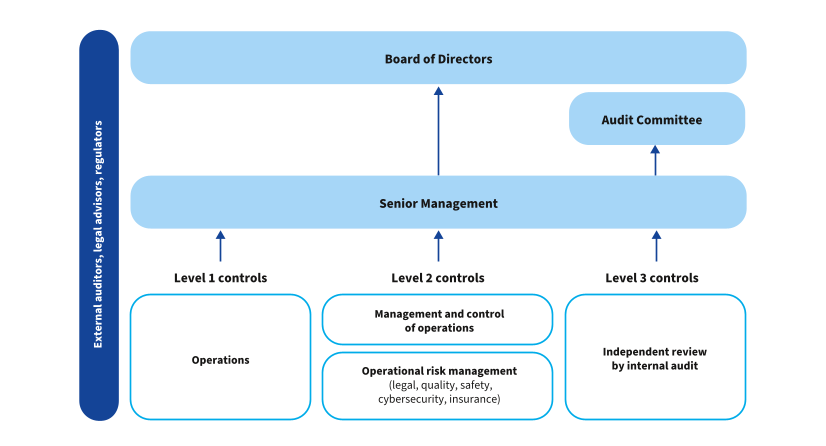
Board of Directors and Audit Committee
Delegated by the Board of Directors, the Audit Committee is responsible for monitoring the preparation of financial information and the effectiveness of internal control, risk management and internal audit systems.
See Section 4.1 – Governance overview for a detailed description of the tasks of the Board of Directors and the Audit Committee.
Senior Management
Senior Management is responsible for deploying the internal control system and overseeing risk mapping. To achieve this, Senior Management relies on the support of the Finance Department and the Audit, Internal Control and Risk Department.
Level 1 controls
The first line of control is made up of operations that formalise and implement operational processes to ensure the control of day-to-day operations and their internal control.
Level 2 controls
Internal control is an integral part of each operational department's mission. The management of the operational departments is responsible for checking that the Level 1 procedures and controls are being properly applied by carrying out Level 2 controls, for example via sampling and by implementing application controls and validation circuits. The management control function may also be responsible for carrying out Level 2 controls.
Lastly, the functional departments are responsible for defining the guidelines and controls to be applied by all the commercial and industrial entities and for managing the operational risks in their respective areas: for example, the Legal, Quality, Standards, Safety and Working Environment, Cybersecurity, Human Resources, Finance and Insurance Departments. These functional departments may also be called upon to verify that Level 1 rules have been applied correctly through Level 2 control campaigns.
With a view to strengthening its internal control and improving coordination, OVHcloud has set up an Audit, Internal Control and Risk Department, which reports to the Group's Finance Department. This department assists the operational and functional departments in setting up their Level 1 and 2 control systems. The Audit, Internal Control and Risk Department also carries out internal control campaigns based on the operational departments' self-assessment of whether controls have been applied correctly. The Audit Committee monitors the rollout of the internal control system.
Level 3 controls
The third line of control is the Audit, Internal Control and Risk Department. On the basis of an annual audit plan, approved by Senior Management and the Audit Committee, audits are carried out in a fully independent manner and are the subject of an audit report which identifies any risks and the action plans needed to mitigate them.
-
3.1ESRS 2 – General information
3.1.1Basis for preparation
3.1.1.1BP-1 – General basis for preparation of sustainability statements
This sustainability statement for the 2025 financial year has been drawn up in accordance with the European Union Corporate Sustainability Reporting Directive (CSRD – directive 022/2464), as transposed into French law by Order no. 2023-1142 of 6 December 2023, and in accordance with the EU Taxonomy Regulation on sustainable activities (Regulation (EU) 2020/852) which establishes a classification system to identify environmentally sustainable activities.
This year, OVHcloud is presenting its annual sustainability information for the consolidated Group in accordance with the European Sustainability Reporting Standards (ESRS), as required by the CSRD.
The same scope of consolidation is used as for OVHcloud's consolidated financial statements. Exclusions from this scope will be specified in the relevant section, where applicable.
Sustainability matters have also been analysed across the Group's upstream and downstream value chains, as have policy and action plans where applicable.
The sustainability statement covers all of OVHcloud's operations, covering the Group's upstream and downstream value chains. The policies, actions and targets are applied throughout the value chain in question, in order to address the impacts, risks and opportunities (IROs) that have been determined as material under the double materiality analysis.
This first report has been drawn up to the best of our understanding of ESRS requirements. This first financial year of applying the directive and materiality analysis is marked by uncertainties over the interpretation of the requirements, the absence of established processes and comparative data, in a few rare cases, as well as a number of difficulties in collecting data, particularly within the value chain.
OVHcloud has not used the option to omit specific information corresponding to intellectual property, know-how or the results of innovation.
3.1.1.2BP-2 – Disclosures in relation to specific circumstances
Time horizons
Unless otherwise specified, the terms "short-", "medium-" and "long-" term used in the analysis are used as defined by ESRS 1. As the reporting period for this analysis starts at end-2024, short-, medium- and long-term are defined as one year or less (2025), two to five years (2026 to 2029) and more than five years (2030 and beyond) respectively.
Use of estimates
In some cases, the Group has used estimates, particularly when obtaining information on the value chain in the case of greenhouse gas (GHG) emissions, or has made interpretations, particularly for the metrics requested for resource inflows, which cannot be measured comprehensively. These estimates are described in the methodological note in Section 3.2.5 – Methodological note for assessing the environmental footprint.
Included by reference
Datapoint
Reference document
Reference document section
ESRS 2 – GOV-1
2025 Universal Registration Document
4.1.2.2 Detailed presentation of the members of the Board of Directors
ESRS 2 – GOV-1
2025 Universal Registration Document
4.1.12 Duties, operation and work of the committees
ESRS 2 – GOV-2
2025 Universal Registration Document
4.1.9 Powers, duties, operation and work of the Board of Directors
ESRS 2 – GOV-3
2025 Universal Registration Document
4.5.2 Compensation and benefits paid to executive corporate officers and non-executive officers
ESRS 2 – GOV-5
2025 Universal Registration Document
2. Risk factors and internal control
ESRS 2 – SBM-1
2025 Universal Registration Document
1. Business overview
ESRS 2 – SBM-3
2024 Universal Registration Document
3. Materiality analysis and CSR risk assessment
ESRS E1 – GOV-3
2025 Universal Registration Document
4.5 Compensation and benefits
European Taxonomy
2025 Universal Registration Document
1.3.1.1 Private Cloud
European Taxonomy
2025 Universal Registration Document
1.3.1.2 Public Cloud
European Taxonomy
2025 Universal Registration Document
1.3.1.3 Web Cloud & Other
European Taxonomy
2025 Universal Registration Document
2.1.2.4 Financial risks
European Taxonomy
2025 Universal Registration Document
5. Note 4.3 Revenue
ESRS S1 – SBM-3
2025 Universal Registration Document
4.5 Compensation and benefits
ESRS S4 – SBM-3
2025 Universal Registration Document
1.3.2 Customer segmentation
-
3.2Environment
3.2.1ESRS E1 – Climate change
At the forefront of the sustainable cloud, since its creation, OVHcloud has integrated sustainability at the heart of its business model by developing industrial innovations to limit its environmental impact. During the 2025 financial year, OVHcloud pursued its climate performance trajectory. On the strength of its commitment to the SBTi, OVHcloud is making climate change mitigation an important part of its Group strategy.
3.2.1.1GOV-3 – Integration of ESG-related performance in executive compensation
OVHcloud has included environmental criteria directly linked to the achievement of its ESG objectives into executive variable compensation (see Sections 3.1.2.3 – GOV-3 – Integration of sustainability-related performance in incentive schemes and 4.5 – Compensation and benefits in Chapter 4 of the URD).
3.2.1.2SBM-3 – Material IROs and their integration into strategy and business models
The table below lists the IROs related to climate change that OVHcloud estimated as material during the double materiality assessment:
Topic
Sub-topic
Type of IRO
Position in the value chain
Time horizon
IRO description
IRO number
Climate
changeClimate
change mitigationNI
OO
ST
Direct GHG emissions generated by datacenters (use of fossil-fueled backup generators, refrigerant leaks, etc.) contributing to climate change
1
NI
OO
ST
Indirect GHG emissions generated by energy purchases to power servers, mainly produced from non-renewable sources, contributing to climate change
2
NI
usVC
ST
Indirect GHG emissions generated in the upstream value chain (production and transport of electronic components, construction of buildings, etc.), contributing to climate change
3
O
OO
ST
Implementation of energy efficiency measures (watercooling) leading to a reduction in scope 2 emissions and related expenditure
4
Climate
change adaptationNI
VC
MT
Lack of or insufficient adaptation to physical risks (natural disasters or extreme climatic events) resulting in a direct threat to the economic, social, physical and psychosocial integrity of end-users (downstream value chain)
5
R
OO
MT
Extreme physical or climatic event causing disruption (or even interruption) to the Group's growth due to a supply disruptions in the upstream value chain
6
R
usVC
MT
Extreme physical or climatic event (excluding access to water) causing disruption (or even interruption) to datacenter operations, resulting in reputational damage, loss of revenue and increased costs (penalties, infrastructure repairs)
7
R
OO
MT
Reinforcement of local regulations on climate change adaptation, generating costs (e.g., investment in infrastructure adaptation)
8
Energy
NI
OO
ST
Energy consumption in the Group's own operations applying pressure on fossil fuel resources
9
NI
usVC
ST
Energy consumption in its value chain, applying pressure on fossil fuel resources
10
Abbreviations:
NI = negative impact; PI = positive impact; R = risk; O = opportunity; VC = value chain; usVC = upstream value chain; dsVC = downstream value chain; OO = own operations;
ST = short term, less than one year; MT = medium term, one to five years.- ▶two physical risks:
- •extreme physical or climatic event causing disruption (or even interruption) to the Group's growth due to a supply shortage in the upstream value chain,
- •extreme physical or climatic event (excluding access to water) causing disruption (or even interruption) to datacenter operations, resulting in reputational damage, loss of revenue and increased costs (penalties, infrastructure repairs);
- ▶one transition risk:
- •reinforcement of local regulations on climate change adaptation, generating costs (e.g., investment in infrastructure adaptation).
In its assessment, OVHcloud takes into account the environmental realities associated with its business model, including external requirements to reduce greenhouse gas emissions and how climate change-related risks affect its business and its value chain. The risks associated with climate change include natural disasters and extreme climatic events, as well as the tightening of regulations governing companies as they adapt to climate change. In this context, a climate risk assessment was carried out based on the analysis of climate risk scenarios described below.
Analysis of climate risk scenarios for OVHcloud
In 2024, OVHcloud carried out a climate risk analysis across all its industrial sites (datacenters and assembly centres), as well as the Roubaix and Croix offices (they share buildings with industrial sites).
The latter, carried out by an external body, uses a climate risk analysis to assess the physical risks for four climate change scenarios mentioned by the IPCC (Intergovernmental Panel on Climate Change), as well as the regional loss experience over four different time horizons (2030, 2040, 2050, 2100), according to which risks may vary (for example, the frequency of heatwaves increasing from 2030, and marine submersion in 2100). The four scenarios, known as SSPs (Shared Socio-economic Pathways), are as follows, ranging from the least risky to the most risky:
- ▶Scenario SSP1-2.6: the scenario describes a future focused on sustainable development, with a global transition to clean energy, reinforced governance and low-carbon lifestyles. CO₂ emissions are falling, limiting warming to around 1.8°C by 2100 compared with the pre-industrial era. This scenario significantly reduces the intensity and frequency of extreme weather events compared with warmer trajectories, while remaining in line with the Paris Agreement.
- ▶Scenario SSP2-4.5: this scenario extends current socio-economic trends, with moderate growth, slow technological progress and persistent inequalities. CO₂ emissions are expected to remain stable until 2050 and then decline, leading to an average global warming of around +2.7 C by 2100 compared with the pre-industrial era. The challenges are medium to high in terms of mitigation and adaptation.
- ▶Scenario SSP3-7.0: a scenario marked by a resurgence of nationalism, low investment in education and technology, and slow and unequal economic growth. In this scenario, GHG emissions are set to double between now and 2100, leading to global warming of around +3.6 C to +4.6 C. The challenges for mitigation and adaptation are very high.
- ▶Scenario SSP5-8.5: intensification of energy-intensive lifestyles, fuelled by massive use of fossil fuels, while benefiting from strong growth and technological progress. In this scenario, CO₂ emissions are already set to double around 2050, and could triple by the end of the century, with global warming reaching around +4.4 C by 2100 (between +3.3 C and +5.7 C depending on the model). Despite high adaptive capacity, the absence of climate policies makes this scenario very risky.
Potential expected effects of the physical risks associated with climate change
Depending on the scenarios, their time horizon and their severity, the potential exposure to physical risks would be the following:
- ▶regarding extreme natural disasters: an increase in events such as floods, droughts, forest fires, cyclones and tsunamis, which can damage infrastructure and disrupt operations;
- ▶regarding resource shortages: risks of occasional or permanent shortages impacting operations and, consequently, a potential tightening of regulations (stricter standards on energy management, water use and eco-design).
- ▶increased investment: the regulatory environment becomes more complex in terms of environmental standards and compliance, requiring additional resources to ensure compliance;
- ▶increased operating costs: for example, heat waves can increase the operating costs of cooling systems. This phenomenon also impacts the sites as regards maintaining good working conditions for the Group's employees;
- ▶disruption of services: inability to provide services in accordance with contractual conditions, resulting in financial compensation or additional costs;
- ▶shortages of raw materials: climate change may cause shortages, making raw materials more expensive.
3.2.1.3IRO-1 – Description of the processes to identify and assess material IROs
OVHcloud identified climate-related material IROs as part of its double materiality assessment, as described above.
As part of its assessment and evaluation of physical risks, the Group relied on historical data, mainly on optimistic and sometimes more pessimistic scenarios, which predict an increase in the frequency and intensity of extreme weather events such as floods, droughts, forest fires, cyclones, etc., that could damage physical infrastructures and disrupt the Group's operations or have a negative impact on its value chain. Scenario SSP1-2.6 was also taken into account in the context of a financial risk generated by the strengthening of environmental regulations causing additional costs.
For the purposes of climate change mitigation, the SSP1 and SSP2 scenarios were considered. Materiality was established by taking into account the level of GHG emissions as they currently stand, without any means of remediation and with a business-as-usual approach. As a topical issue, the environmental impact of datacenters and their emissions is inevitably a key topic for the Group.
With regard to energy, due to the impact of datacenters on energy appropriation – particularly with the growth of generative AI (artificial intelligence) – the Group identified two negative impacts both for its own operations and for its value chain.
3.2.1.4E1-1 – Transition plan
3.2.1.4.1Mitigation plan
OVHcloud is putting GHG emissions reduction at the heart of its ambitions, by focusing on three main priorities:
- ▶reduction of compressible emissions by 2030;
- ▶involvement of the ecosystem: partners, customers, suppliers and employees in a process to reduce their carbon footprint;
- ▶contribution to increasing carbon sinks for all residual emissions.
OVHcloud developed a short-term strategy leading to the objectives described above. These objectives have been developed by incorporating the resources required to achieve them into the Group’s business plan.
Basis of analysis
OVHcloud has been committed since 2023 to a process following the SBTi, an international benchmark that helps organisations to align their decarbonisation strategy with the pathway defined by the Paris Agreement.
The SBTi deemed OVHcloud's two near-term objectives, established according to a specific sectoral pathway (softwares & services), as being compatible with the 1.5°C global objective.
The reduction in compressible emissions is reflected in the near-term commitments made and validated by the SBTi at the end of 2024.
Scope
Type
Ambition
Target year
Base year
Near-term 1
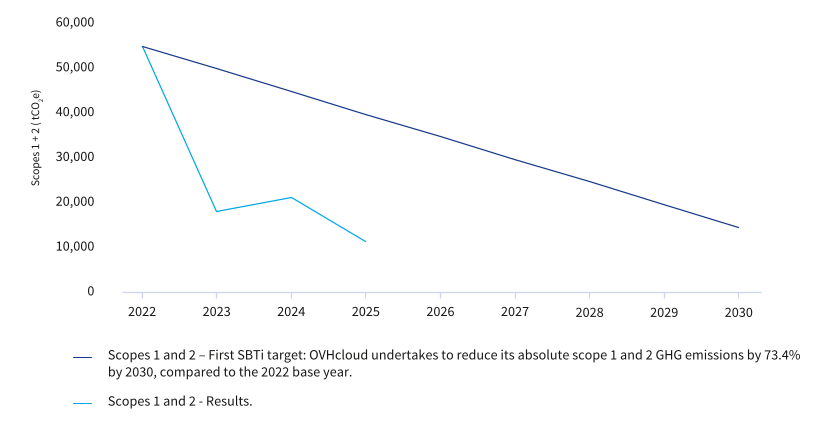
1 and 2
Absolute
-73.40%
2030
2022
Near-term 2
3
Economic intensity (GEVA(1))
-52.00%
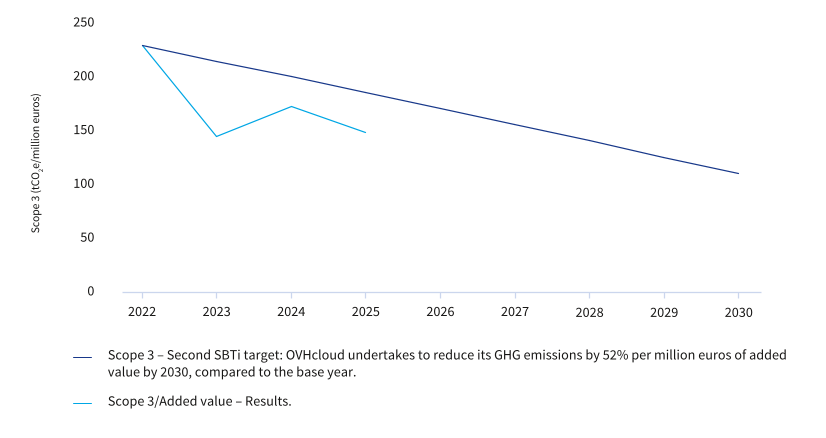
2030
2022
- (1)GEVA: Greenhouse gas Emissions per unit of Value Added, expressed in tCO2e per million euros of value added. Value added is defined as the sum of Recurring EBITDA and staff costs, in millions of euros.
Exclusion or non-exclusion of the EU Paris-aligned Benchmarks
OVHcloud is not engaged in activities meeting the exclusion criteria of Articles 12.1 (1) and 12.2 (2) of Commission Delegated Regulation (EU) 2020/1818 of 17 July 2020.
Locked-in emissions
OVHcloud has no locked-in emissions, as the Company's assets are mainly powered by electricity grids.
Explanation of decarbonisation levers and action plan
- ▶decarbonising the energy mix and improving energy efficiency (scopes 1 and 2);
- ▶purchasing more efficient equipment and implementation of circularity (scope 3).
An exhaustive list of decarbonisation levers and their implementation is presented in Section 3.2.1.6 – E1-3/E4 Actions and targets in relation to climate change policies.
Approval of the plan by the administrative, management and supervisory bodies
The near-term commitments and Group CSR policy were approved by the Group's Executive Committee and Senior Management, signatories of the SBTi commitment letter.
3.2.1.4.2Adaptation plan
In terms of adaptation, OVHcloud has prioritised adaptation to physical risks that could lead to business interruption.
These initiatives are part of a proactive approach to adapting to the impacts of climate change, thereby ensuring the sustainability of OVHcloud's infrastructure and services.
The Group implemented the “hyper resilience” program, aimed at strengthening physical security and continuity of services in the face of extreme events. This programme includes the construction of datacenters that meet enhanced security standards.
In addition, through the analysis of climate scenarios, specific action plans for each site were drawn up and presented to the risk monitoring governance body. Measures were taken to mitigate the prevailing risks in order to limit the risk of business interruption or service interruptions (hail, storms, cold weather, flooding, etc.) at the various locations where the Group's infrastructures are located. The Group also carries out risk analyses before acquiring new sites.
The Group is still studying medium- and long-term priorities for reducing its exposure to the risks quantified in the various scenarios.
3.2.1.5E1-2 – Policies related to climate change mitigation and adaptation
Policy
Topic
In charge of policy implementation
Topics covered
CSR policy
Climate change mitigation & GHG emissions
Strategy Department
Improve energy efficiency
Draw up contracts regarding the supply of renewable electricity
Reduce GHG emissions
Improve environmental transparency
Supplier Code of Conduct
Climate change mitigation & GHG emissions
Purchasing Department
Reduce GHG emissions
CSR policy
Energy
Strategy Department
Improve energy efficiency
Draw up contracts regarding the supply of renewable electricity
Adhere to the Energy Code of Conduct
Supplier Code of Conduct
Energy
Purchasing Department
Improve energy efficiency
Risk management policy
Climate change adaptation
Risk and Internal Control Department
Manage physical risks
CSR policy
Climate change adaptation
Strategy Department
Adapt to climate change through vertical integration and a circular, resilient approach to IT server production
OVHcloud launched its approach to climate change in 2022, fine-tuning its objectives and structuring its approach by mobilising various players in the Group and its value chain. With this in mind, various Group departments are supporting this transition by developing committed policies.
The CSR policy covers all Group entities with regard to environmental topics and defines environmental targets.
The Supplier Code of Conduct and the sustainable procurement policy reinforce this approach by incorporating climate change-related criteria. The Purchasing Department requires its suppliers to reduce their GHG emissions, by prioritising low-carbon solutions and raising their employees' awareness of climate matters, and to provide OVHcloud with the necessary data to calculate its own carbon emissions accurately and within a reasonable timeframe. It also requires its suppliers to commit to improving their energy efficiency.
3.2.1.6E1-3/E1-4 – Actions and targets related to climate change policies
Topic
coveredTarget
Methodology
for setting targetsScope
Timing
FY2025
annual resultsActions
Improve
energy
efficiencyPUE lower than 1.26
Continuous
improvement of PUEDirectly held datacenters excluding BHS1-7
Continuous
1.24
Deploy latest-generation cooling modules
Participate in the Code of Conduct in relation to energy efficiency in datacenters
Modernise the oldest datacenters
Disconnect unused equipment
Deploy more efficient equipment in the electricity chain
Optimise operating temperatures
Continue research and development on cooling systems
Maintain and extend ISO 50001 certification for our datacenters
Implement the energy performance plan
Explore and implement recovery systems
Draw up contracts regarding the supply of renewable electricity
100% REF (Renewable Energy Factor)
To achieve its decarbonisation objectives, the Group must source 100% of the energy it purchases from renewable sources
Directly held datacenters
2025
100%
Draw up PPAs (Power Purchase Agreements)
Acquire Energy Attribute Certificates
Substitute domestic heating oil with HVO 100 (100% renewable biofuel made from vegetable oils, residual oils or waste)
Reduce scope 1 and 2 GHG emissions
Target of reducing scope 1 and 2 GHG emissions by 73.4% by 2030
Near-term SBTi methodology
Group
2030
79.4% reduction (in line with the trajectory)
Improve energy efficiency
Draw up contracts regarding the supply of renewable electricity
Reduce fugitive emissions associated with HFCs (hydrofluorocarbons)
Reduce scope 3 GHG emissions
52% of scope 3 emissions per unit of value added by 2030
Near-term SBTi methodology
Group
2030
36% reduction (in line with the trajectory)
Implement circularity for IT equipment
Buy more efficient equipment
Adopt an optimised freight model
Better travel
Manage IT assets more effectively
Improve environmental transparency
Roll-out the environmental reporting tool for customers (Impact tracker)
Internal project management
Group
2026
Rolled out
Provide customers with the GHG emissions of their cloud service (continuity with the carbon calculator)
Improve energy efficiency
Constant attention is paid to energy efficiency, particularly watercooling which is the foundation and cornerstone of the cooling technologies rolled out for over 20 years and used on a large scale. This technology eliminates the need for air conditioning in server rooms, with significant benefits in terms of cost management and reduced environmental impacts.
Direct watercooling removes heat from the most energy intensive components, such as processors (CPU, CGU), and the air (which is then cooled inside the rack using water through a heat exchanger) and removes heat from other components. The heated water is then cooled using dry cooling towers. OVHcloud stands out with its closed circuit system that reduces the leakage of fluid, and by the use of dry coolers and the absence of air conditioning in the server rooms. In addition to being very efficient in terms of water and energy consumption, OVHcloud’s watercooling technology has relatively low maintenance costs.
The deployment of the latest-generation cooling systems (5th generation) continued in 2025, enabling the infrastructure to be operated at higher water temperature regimes, with higher efficiency (partial PUE of 1.06).
The roll out of new electrical units is being accompanied by the installation of more efficient equipment (high-yield UPS or inverters, busbars).
The plan to modernise the oldest datacenters, such as RBX1 (Roubaix 1), is currently underway. This upgrade will improve the Group's energy efficiency, as the older datacenters are less energy-efficient than newer ones.
Remaining within the framework of eliminating waste, the Company's own datacenters are implementing optimised settings in rooms that are still air-conditioned (network rooms, technical rooms or battery rooms). Servers not in use are switched off to avoid unnecessary energy consumption.
Implementation of the energy performance plan, in conjunction with the French Regional Department for the Environment, Planning and Housing (DREAL – Direction Régionale de l'Environnement, de l'Aménagement et du Logement), is ongoing at Gravelines, while studies into waste heat recovery are being carried out at the Roubaix and Strasbourg sites.
- ▶heat offices at the Limburg site (Germany), saving around 100,000 kWh of gas;
- ▶preheat the Roubaix generators.
Energy performance can be assessed according to the processes implemented within the Group. The Group is constantly making strides in its energy performance, as demonstrated by obtaining ISO 50001 certification for improving energy performance and by the continuous improvement of the PUE energy performance metric. This metric stood at 1.24 at the end of FY2025 (compared with 1.26 at the end of FY2024).
This year, OVHcloud extended ISO 50001 certification to its European datacenters Erith (UK), Limburg (Germany) and Ożarów (Poland), in addition to the French datacenters, which already received the certification in previous years.
OVHcloud also contributes to the EU Code of Conduct on Energy Efficiency, with all its own operated datacenters now registered, including those in North America.
The IT energy consumption (consumption of electricity by IT systems) of directly operated datacenters was measured in all datacenters with the exception of the first Beauharnois datacenters (BHS). The Group deemed that this represented a relevant and representative panel. The coverage rate will naturally increase to 100% as the first BHS datacenters are upgraded in the future.
Draw up contracts regarding the supply of renewable electricity
The supply of renewable energy is a target in its own right for OVHcloud. For its directly held datacenters, the Group set itself the target of achieving 100% renewable electricity supply by 2025.
- ▶in France, for 40 GWh/year, in production since 1 January 2025;
- ▶in Germany, for 25 GWh/year, in production since 1 January 2025;
- ▶in Poland, for 5 GWh/year, which will come into production in 2026.
Energy Attribute Certificates (EACs) are also acquired in the various countries in which OVHcloud operates its datacenters.
In addition to electricity, OVHcloud's datacenters consume domestic heating oil on a small scale. This heating oil is used to produce electricity as a last resort, via the emergency generators installed in the datacenters.
Domestic fuel consumption, although low, is as a result of maintenance and shutdown tests (except in the event of a power cut).
OVHcloud is gradually replacing the fossil fuel (domestic heating oil) used by its generators with HVO fuel, derived from organic waste and residues (which do not compete with food crops).
Reduce scope 1 and 2 GHG emissions
The reduction in scope 1 and 2 GHG emissions was essentially driven by the topics covered in the two previous paragraphs:
Another source of GHG emissions comes from the use of refrigerants (HFCs) in datacenters. Fugitive emissions, caused by accidental leaks in air conditioning systems, are the cause.
The majority of refrigerants installed in OVHcloud's directly operated datacenters are at its oldest datacenter, RBX1. This datacenter will be upgraded over the coming years, and will be equipped with the watercooling technologies now present in the latest datacenters. This will not only improve energy performance, but also eliminate the use of HFCs, thereby eliminating the risk of leakage at the source of the problem.
More generally, particular attention is paid to complying with the Kyoto Protocol and the Kigali Amendment: using fewer and better quality HFCs (i.e., with lower global warming powers). Since 2011, the server rooms operated in OVHcloud's own datacenters have had no direct cooling, and do not rely on HFCs. Since 2020, the UPS rooms have also been cooled using watercooling. Only the battery rooms and network rooms are currently air-conditioned in OVHcloud datacenters, i.e., less than 5% of the heat to be evacuated from said datacenters.
Improve energy efficiency
Reduce energy consumption
- •Disconnect unused servers in datacenters
- •Disconnect unused equipment from the electrical supply chain
Optimise the energy efficiency of electrical systems
- •Optimise the performance of electrical systems by introducing more efficient elements (transformers, inverters and bus ducts)
Optimise cooling systems
- •Increase the controlled ambient temperature in electrical rooms and network rooms
- •Carry out innovation projects on patented cooling systems (new heat exchangers, new horizontal bays and associated watercooling module, immersive cooling in a dielectric liquid)
- •Implement the energy performance plan with the DREAL at the Gravelines site, and, in general, the action plans relating to ISO 50001 certification of our European datacenters
- •Explore and implement systems to recover wasted heat (use heat from servers to heat offices, preheat emergency generators, or make it available to external heating networks)
Reduce fugitive emissions associated with HFCs
- •Reduce the quantity of refrigerants still used in equipment rooms by making greater use of watercooling, use refrigerants with a lower global warming potential (PRG)
Draw up contracts regarding the supply of renewable electricity
Acquire renewable Energy Attribute Certificates
- •Cover electricity supply contracts with certificates of origin and ensure that they are low-carbon
Substitute fossil fuels with HVO (hydrotreated vegetable oil)
- •Supply datacenters with non-fossil HVO fuel to limit net emissions from the combustion of fuels by emergency generators
Monitoring of short-term target 1 (tCO2e)
Reduce scope 3 GHG emissions
As the Group's largest source of emissions in the 2022 baseline year – with more than 62,700 tCO2e – the purchase of IT components is the main item on which OVHcloud is taking action.
The carbon footprint of IT components was calculated based on data from comparative studies carried out by an independent third-party expert in sustainable IT and Green IT.
OVHcloud has since set up a process for collecting primary data from its suppliers in order to better identify these component purchases.
In 2025, the Group obtained the emission factor for 64% of its IT components from its suppliers (as a percentage of functional units).
Another way of avoiding waste is to implement the circular economy for buildings and IT components. Although this part is detailed in Section 3.2.3 – ESRS E5 – Resource use and circular economy, positive external factors also contribute to OVHcloud’s carbon footprint. The rate of reused components is a good indicator for quantifying avoided emissions, since a reused component is a component that has not been purchased.
With regard to in-house equipment needed by employees, OVHcloud implemented voluntary actions, such as awareness-raising, preventive maintenance and repairs, with the aim of extending their lifespan. At 31 August 2025, around 40% of laptops given to employees were over three years old, and 65% of smartphones were more than two years old.
With regard to employee commuting, the Group introduced measures to promote soft mobility, rewarding employees who cycle or take public transport to work.
Circular economy
- •Optimise the lifespan of a component without compromising on performance
- •Renovate existing buildings to build new datacenters
- •Recycle packaging (foams, for example)
- •Monitor products sold to brokers to ensure an environmentally friendly second life
Sustainable supply chain
- •Encourage suppliers to improve the carbon footprint of components (Supplier Code of Conduct commitment): measure the carbon footprint of components
- •Encourage suppliers to improve the carbon footprint of packaging: participate in packaging reduction projects
Freight
- •Optimise logistics through partial loads
- •Select road freight based on GHG emissions
- •Limit air flows through supply chain optimisation
- •Take the carbon impact into account in the arbitration of emergency air cargo
Efficient management of work tools
- •Include environmental criteria in calls for tender
- •Extend the lifespan of equipment
Sustainable travel
- •Limit flights for business travel when rail travel is possible
- •Encourage soft mobility (cycling, public transport), car-pooling and eventually electric/hybrid vehicles
Monitoring of short-term target 2 (tCO2e/million euros)
Improve environmental transparency
Environmental labelling is a powerful tool for users to measure the impact of the products and services consumed. OVHcloud has developed a “carbon calculator”, now referred to as the Impact Tracker, to give customers a better understanding of their cloud infrastructure’s carbon footprint, and help them with their environmental transition and consumption choices. Its name change follows OVHcloud’s research work to make this tool multi-criteria (see Section 3.2.2 – ESRS E3 – Water and marine resources and Section 3.2.3 – ESRS E5 – Resource use and circular economy).
This tool is the result of a rigorous design process of developing a reliable, robust and exhaustive methodology, as well as rapid IT development. The methodology, which was audited and certified by an independent consulting firm specialising in sustainable IT, is based on LCA (life cycle analysis) principles, reference databases for environmental impact factors, such as the French Agency for Ecological Transition (Agence de l'environnement et de la maîtrise de l'énergie – ADEME) Base IMPACTS® 3.0, and the first recommendations of ADEME’s Product Category Rules for digital services. To enhance the reliability of its solutions' environmental labelling, OVHcloud has worked in collaboration with its main suppliers, the academic world (Inria) and associations (Boavizta) to improve its knowledge about the carbon footprint of their activities. The Group now has more precise data on the supply of access to energy, specifying if they are "location-based" or "market-based", and a significant proportion of its components, taking into account any retrofitting.
OVHcloud launched the first version of its carbon calculator in July 2023 for the Bare Metal Cloud range. The first enhancement for Hosted Private Cloud customers took place in the first quarter of the 2024 financial year. Barely three months after it was made available to customers, OVHcloud's carbon calculator was awarded the Green Trophy at The Big Green forum, an event dedicated to CSR. The award recognises the technical sophistication of the calculator's methodology and its comprehensiveness. OVHcloud is the first company to provide such comprehensive environmental information to its customers. Since then, the tool has been enhanced with more precise calculation elements, thanks to the dual display of emissions linked to the use phase (market-based and location-based) and also to the manufacturing phase, thanks to the inclusion of component reconditioning.
Following the production launch of the tool in 2023, and its subsequent update in 2024, OVHcloud decided to extend the portfolio of products covered by the tool. In 2025, the Public Cloud sector integrated the tool through compute and storage products. This sector represents a growing share of the Group’s revenue and a methodological challenge for the extension of the tool (the physical layer of the infrastructures is totally abstract/invisible for public cloud customers).
Accessible to customers directly from their OVHcloud space, the tool integrates the estimated power consumption of servers based on the monitoring of OVHcloud datacenters. It then maps them to their carbon emissions equivalent, taking into account cooling and network systems as well as transport, manufacturing, end-of-life and waste management, to provide a complete picture of the current carbon footprint. The results for cloud usage, which each user can download, are broken down into three emission categories:
- ▶the manufacturing phase: upstream GHG emissions linked to the purchase and assembly of components;
- ▶the use phase: electricity-related emissions;
- ▶ancillary emissions: other indirect emissions such as freight and the impact of employees – known as "operations".
Below is an example of a document produced by Impact Tracker
OVHcloud’s aim is to establish best practices in the supply chain by ripple effect, and in particular, data-driven decision making.
3.2.1.7E1-5 – Energy consumption and mix
The table below shows the energy consumption of OVHcloud's own datacenters. This is expressed in GWh and by type of energy:
Energy consumption
Unit
2024
2025
Total energy consumption of directly held datacenters
GWh
485
516
Energy consumption from fossil sources
GWh
N/A
1
Fossil fuel energy rate
%
N/A
0
Energy consumption from nuclear sources
GWh
N/A
0
Nuclear source energy rate
%
N/A
0
Energy consumption from renewable sources
GWh
446
515
Renewable source energy rate
%
92%
100%
Self-generated renewable energy consumption
GWh
0
0
Purchased renewable energy consumption
GWh
446
515
Renewable fuel energy consumption
GWh
0
0
3.2.1.8E1-6 – Gross scopes 1, 2 and 3 GHG emissions
The table below shows OVHcloud’s GHG emissions statistics for each of scopes 1, 2 and 3. The year 2022 is also presented as a baseline year. It should be noted that the Group measures its GHG emissions in accordance with the GHG Protocol.
Scope
GHG category number
Type
GHG category name
Unit
2022
2024
2025
Scope 1
-
Direct emissions from stationary combustion sources
tCO2e
562
420
671
-
Direct emissions from mobile combustion sources
tCO2e
121
137
139
-
Direct emissions from physical or chemical processes
tCO2e
0
0
0
-
Direct fugitive emissions
tCO2e
655
1,371
515
Total scope 1
tCO2e
1,338
1,928
1,325
Scope
GHG category number
Type
GHG category name
Unit
2022
2024
2025
Scope 2
Location-
basedIndirect emissions from electricity consumption
tCO2e
53,625
62,132
58,087
-
Indirect emissions linked to the consumption of steam, heat or cooling
tCO2e
0
0
0
Market-
basedIndirect emissions from electricity consumption
tCO2e
53,625
19,276
9,981
Total scope 2 Location-based
tCO2e
53,625
62,132
58,087
Total scope 2 Market-based
tCO2e
53,625
19,276
9,981
Scope
GHG category number
Type
GHG category name
Unit
2022
2024
2025
Scope 3
1
-
Purchased goods and services
tCO2e
10,186
9,032
16,305
2
-
Capital goods
tCO2e
69,724
53,735
48,323
3
Location-
basedFuel and energy-related activities
tCO2e
11,911
22,729
21,753
3
Market-
basedFuel and energy-related activities
tCO2e
11,911
19,307
23,974
4
-
Upstream transportation and distribution
tCO2e
5,948
928
2,927
5
-
Waste generated in operations
tCO2e
283
717
638
6
-
Business travel
tCO2e
1,338
1,429
1,402
7
-
Employee commuting
tCO2e
2,709
2,235
2,175
8
-
Upstream leased assets
tCO2e
9,103
17,447
5,197
9
-
Downstream transportation and distribution
tCO2e
0
0
0
10
-
Processing of sold products
tCO2e
0
0
0
11
-
Use of sold products
tCO2e
1,302
1,094
616
12
-
End-of-life treatment of sold products
tCO2e
0
0
0
13
-
Downstream leased assets
tCO2e
0
0
0
14
-
Franchises
tCO2e
0
0
0
15
-
Investments
tCO2e
0
0
0
16
-
Other indirect emissions
tCO2e
0
0
0
Total scope 3 Location-based
tCO2e
112,504
109,346
99,336
Total scope 3 Market-based
tCO2e
112,504
105,924
101,557
Additional metrics
Metric
Type
Unit
2022
2024
2025
Total scope 1
tCO2e
1,338
1,928
1,325
Total scope 2
Location-based
tCO2e
53,625
62,132
58,087
Total scope 2
Market-based
tCO2e
53,625
19,276
9,981
Total scope 3
tCO2e
112,504
105,924
101,557
Total scopes 1 and 2
Location-based
tCO2e
54,963
64,060
59,412
Total scopes 1 and 2
Market-based
tCO2e
54,963
21,204
11,306
Total scopes 1, 2 and 3
Location-based
tCO2e
167,467
173,406
158,748
Total scopes 1, 2 and 3
Market-based
tCO2e
167,467
127,128
112,863
Total scopes 1, 2 and 3/revenue
Location-based
tCO2e/€m
213
175
146
Total scopes 1, 2 and 3/revenue
Market-based
tCO2e/€m
213
128
104
Short-term scopes 1 and 2 target
Market-based
tCO2e
54,963
44,875
39,830
Scope 1 emissions covered by ETS(1)
tCO2e
63
118
136
Percentage of scope 1 emissions covered by ETS(1)
%
5
6
10
Scope 3/GEVA(2)
tCO2e/€m
230
173
149
Short-term scope 3/GEVA(2) target
tCO2e/€m
230
201
186
Revenue
€ millions
788
993
1,085
Recurring EBITDA
€ millions
277
372
421
Personnel expenses
€ millions
211
239
262
Value added(2)
€ millions
488
611
683
- (1)ETS: Emissions Trading System.
- (2)GEVA: Greenhouse gas Emissions per unit of Value Added.
Analysis of changes
- ▶Scope 1 emissions amounted to 1,325 tCO2e in FY2025. Emissions have fallen since 2024 and are stable compared with 2022.
- ▶Fugitive emissions (unintentional gas emissions) related to refrigerant (HFC) leaks are returning to 2022 and 2023 levels.
- ▶Emissions from the vehicle fleet are stable.
- ▶Emissions linked to the operation of emergency generators are increasing as the Group grows. These are mainly used for testing and maintenance. To date, HVO fuel has not been accounted for.
- ▶Location-based: despite the increase in the Group's electricity consumption, emissions are falling due to the improved performance of France's nuclear power plants since 2024, offsetting emissions linked to growth in areas with more carbon-intensive electricity. Scope 2 location-based emissions amounted to 58,087 tCO2e.
- ▶Market-based: purchases of EACs for the Vint Hill site in Virginia resulted in emissions reductions, compared to 2024. All the other datacenters were covered in previous years. Residual emissions, which are not covered by EACs, are due to energy consumption by datacenters that are not operated directly by the OVHcloud Group, in shared datacenters or Local Zones. Scope 2 market-based emissions amounted to 9,981 tCO2e.
- ▶Category 1 (Purchased goods and services): emissions increased due to greater use of outsourced services.
- ▶Category 2 (Capital goods): emissions decreased thanks to a purchasing policy that accounts for the carbon footprint of the IT equipment used by the manufacturers to construct the servers.
- ▶Category 3 (Fuel and energy-related activities): location-based emissions decreased due to the increased performance of France’s nuclear power plants since 2024. Market-based emissions increased due to greater use of biomass for energy at Vint Hill.
- ▶Category 4 (Upstream transportation and distribution): the increase in emissions is explained by the greater use of air freight this year. The Group is currently working to limit this practice by favouring sea freight, particularly for transfers between the Croix and Beauharnois sites.
- ▶Category 8 (Upstream leased assets): emissions decreased, mainly due to a more accurate quantification of the impacts relating to the backbone of the OVHcloud network. Previously, OVHcloud extrapolated the results of a study revised in 2021 ("Report: evaluation of the carbon footprint of the transmission of a gigabyte of data on the RENATER network") and applied them to the backbone of its own network.
- This year, OVHcloud developed a new methodology, assessing the impacts associated with POPs (“Point of Presence” leases) throughout the lifecycle, terrestrial links (optical fibres) and undersea telecommunications cables separately.
- The following blog page details the methodology used: https://blog.ovhcloud.com/ovhcloud-backbone-network-environmental-impact-assessment-methodology/
- Emissions due to electricity consumption by leased offices, recorded in this category, remain stable.
- ▶Category 11 (Use of sold products): emissions are falling thanks to the improved performance of France's nuclear power plants since 2024, reducing emissions linked to the use of products by our customers: switchboards, VOiP (Voice Over Internet Protocol), modems.
- ▶two physical risks:
-
3.3Social
3.3.1Human rights
3.3.1.1Human rights policy
Through its approach and its commitment to human rights, OVHcloud's human rights policy aims to reflect a vision of the world and the type of society in which everyone wishes to live. It is based on the Ten Principles of the UN Global Compact and is broken down as follows:
- ▶ensuring equal treatment and opportunities. OVHcloud is committed to combating all forms of discrimination and harassment by applying a zero-tolerance policy. OVHcloud is committed to promoting a human-centred environment, characterised by respect and diversity, and to supporting its employees based solely on competence. OVHcloud does not practice any form of discrimination or harassment linked to gender, disability, family background, political involvement, religious faith, sexual orientation, trade union activities or ethnic origins;
- ▶guaranteeing freedom of expression and dialogue with the Group's customers, employees and suppliers;
- ▶implementing freedom of association and collective bargaining. OVHcloud attaches great importance to social dialogue, a guarantee of involvement and collective performance, and maintains ongoing high-quality relationships with employees and their representatives within the bodies created for this purpose;
- ▶ensuring a workplace free from all forms of moral and sexual harassment, therefore fostering interaction in a human-centred, diverse environment that drives the Group's business. OVHcloud is committed to maintaining a safe and healthy working environment, ensuring that safety procedures are understood by each employee and that each individual action does not entail any risk. Every employee has the right to be treated with respect and dignity. The Group refuses to ignore any situation that could lead to harassment or unhappiness among its employees;
- ▶providing safe and healthy workplaces for all employees on our sites. In order to promote the prevention of health and safety risks, OVHcloud has defined procedures aimed at complying with legal requirements in terms of health, safety and the environment in all countries where the Group operates, and at implementing all satisfactory measures to protect the health and physical integrity of workers, customers and local communities in order to protect the environment. OVHcloud is committed to maintaining a safe and healthy working environment, ensuring that all its employees are aware of emergency procedures and that individual actions do not entail any risk. The implementation of these procedures involves engagement across all levels of management and the accountability of all employees. In addition, the Group ensures that all employees are aware of and comply with rules regarding health, safety and working conditions, and that they report any behaviour, installation or situation that could lead to an accident to management (see Section 3.3.2.4 – Management of impacts related to health and safety);
- ▶fighting against child or forced labour or human trafficking. OVHcloud does not employ minors or children in its businesses and strives to ensure that its suppliers do not engage in any form of child labour along their supply chains. OVHcloud does not use forced labour, servitude or modern slavery and all its employees have an employment contract, which they can terminate at any time in accordance with the applicable laws. The Group respects labour law in all the countries where it operates;
- ▶ensuring the protection and confidentiality of data entrusted to us by customers and, more generally, by all stakeholders. The Group is also campaigning for a European cloud, guaranteeing the technological independence of Europe and the sovereignty of its data. In order to guarantee the protection of the data entrusted to it, OVHcloud deploys all necessary means in terms of cybersecurity and physical protection of its sites. In addition, internal procedures for IT security and raising employees’ awareness of the risk of IT attacks, in particular by carrying out simulations, have been put in place. OVHcloud has adopted a personal data processing policy that complies with the strictest regulations and applies to all its entities and employees. The policy guarantees customers that their data are secure and ensures compliance with the General Data Protection Regulation and all applicable national legislation, such as the UK Data Protection Act, the Australian Data Protection Act and Quebec's Law 25.
- ▶supporting the right to education. OVHcloud invests in training and development by creating training courses adapted to the needs of its employees (see Section – 3.3.2.5 Management of impacts related to talent management and skills development).
Since 2023, the human rights policy has applied to all OVHcloud entities and subsidiaries (excluding US entities), regardless of their location in the world, as well as to all stakeholders.
- ▶the Ten Principles of the UN Global Compact. These fundamental principles concern human rights, labour law, environmental law and anti-corruption;
- ▶the Universal Declaration of Human Rights;
- ▶the International Covenant on Civil and Political Rights;
- ▶the International Covenant on Economic, Social and Cultural Rights;
- ▶the ILO Declaration on Fundamental Principles and Rights at Work;
- ▶the Convention on the Elimination of All Forms of Discrimination against Women;
- ▶the Convention on the Rights of the Child;
- ▶the Convention on the Rights of Persons with Disabilities;
- ▶the International Convention on the Elimination of All Forms of Racial Discrimination.
It also complies with local regulations on the fight against modern slavery, in particular the UK's Modern Slavery Act.
3.3.1.2Governance in relation to the human rights policy
The human rights policy was drafted by the Ethics and Compliance Department in consultation with the various stakeholders, and validated by the Group's Executive Committee (Comex) and the Board of Directors. On an operational level, the human rights policy is implemented by various OVHcloud contributors (Comex, Human Resources Department, Purchasing Department, Legal Department, etc.) and may be reinforced by specific policies, charters or documents (HSE policy – health, safety and environment, diversity policy, etc.), as well as by versions of these policies adapted at local levels.
The commitments and monitoring of the human rights policy are drawn up and monitored by the CSR Steering Committee, as set out in Section 3.1.2.1 – GOV-1 – The role of the administrative, management and supervisory bodies.
3.3.1.3Ensuring compliance with commitments to protect human rights in the value chain
All the Group's policies and procedures, whether they concern its employees, the workers in its value chain or its customers, are based on the principles set out in this chapter. To ensure that it is properly applied and disseminated, the policy is available and can be consulted on the corporate.ovhcloud.com website(2).
OVHcloud is aware of its duty to the community and is taking action to minimise its impact on the environment and make a positive contribution to it. OVHcloud is committed to protecting human rights at all levels and at all stages of its value chain.
This policy is implemented
- ▶through the code of ethics, which sets out the Group's commitments to its stakeholders on a day-to-day basis;
- ▶in terms of purchasing, OVHcloud requires its suppliers, through its Supplier Code of Conduct, to respect human rights, and reminds them of the obligations relating to the non-use of child labour and forced labour, the fight against discrimination and harassment, freedom of association, as well as compliance with legislation on working hours and health and safety measures. Any breach will automatically justify the termination of business relations;
- ▶the "ROGER" (Respect OVHcloud Guidelines & Ethical Rules) platform enables workers in the value chain to report breaches in this area. The whistleblowing system is accessible 24 hours a day, 7 days a week (24/7) for stakeholders.
In general, OVHcloud handles all reports relating to the human rights policy from communities or customers.
Above all, these measures ensure that OVHcloud conducts its business in an ethical manner that respects human rights in all spheres of its business practices.
In the United States, OVHcloud US is committed to respecting human rights through its code of ethics and internal regulations for employees, which were drawn up by the entity's legal and human resources departments. It is committed to respecting rules concerning equal opportunities, fair treatment and respect for each individual internally, in order to guarantee a healthy and safe environment for its employees. It also encourages its employees to choose partners who respect good working conditions in their practices (decent wages, safety, etc.) and to report any non-compliant behaviour.
-
3.4Business conduct
3.4.1IRO-1 – Description of the processes to identify and assess material impacts, risks and opportunities (IROs)
As part of the identification and assessment of material IROs, the Group has identified impacts and risks relating to governance, corporate culture, ethics and its supply chain.
The process for identifying material IROs is detailed in Section 3.1.4.1. IRO-1 – Description of the process to identify and assess material IROs. OVHcloud has identified the following material IROs related to governance:
Topic
Sub-topic
Type of IRO
Position in the value chain
Time horizon
IRO description
IRO number
Governance
Governance
and business ethicsPI
OO
ST
A corporate culture driven by its governance, which promotes an effective and healthy corporate culture, strengthening the sense of belonging and commitment within the Group
36
NI
OO
MT
Failure to prevent unethical behaviour within the Group and implementation of a compliance programme, leading to non-compliance with commitments (code of ethics) and loss of customer confidence
37
R
OO
MT
Unstable governance resulting in reputational damage, loss of investor and customer confidence, financial losses, and a deterioration in the social climate (protests, high staff turnover), leading to a decline in operational and financial performance
38
R
OO
MT
Corruption, influence peddling, any breach of the Code of Conduct (bribes are a form of corruption) resulting in reputational damage and leading to financial penalties (judicial and administrative)
39
R
OO
MT
Anti-competitive practices leading to damage to the Group's reputation, a loss of confidence on the part of stakeholders and financial penalties (judicial and administrative)
40
Responsible and resilient sourcing
NI
usVC
MT
Potential supply chain disruption, impacting end consumers (price increase, project delays, impact on service performance, etc.)
41
R
OO/usVC
MT
Significant dependence on suppliers of electronic components (and their value chain) or IT licences, presenting operational risks in the event of disruptions or supply chain congestion and limited scope for negotiating prices
42
Abbreviations:
NI = negative impact; PI = positive impact; R = risk; O = opportunity; VC = value chain; usVC = upstream value chain; dsVC = downstream value chain;
OO = own operations; ST = short term, less than one year; MT = medium term, one to five years. -
3.5Entity specific: cybersecurity and data protection
3.5.1IRO-1 – Description of the process to identify and assess material IROs
As part of its double materiality assessment, OVHcloud has identified challenges related to cybersecurity, data protection and data sovereignty as material for the Group, both in terms of the impact on its customers and the financial impact on the Group.
Cybersecurity is a central issue in the Group’s business. Security and data breaches have a major potential impact both on the Group’s customers and on the Group itself. But this also poses an opportunity for the Group, as it is equipped with high-performance security systems to meet the needs of its customers.
Data sovereignty is also one of the major pillars of OVHcloud's strategy, and represents an advantage over its competitors. It enables the Group’s customers to entrust their data to a system that protects them from extraterritorial interference at a large proportion of its sites.
Topic
Sub-topic
Type of IRO
Position in the value chain
Time horizon
IRO description
IRO number
Entity specific
Cybersecurity and data protection
NI
OO
MT
Cybersecurity breaches within the Group, leading to business interruptions for customers, breaches of data confidentiality (sensitive or non-sensitive) and the potential loss of customers’ intellectual capital
43
PI
OO
ST
Offering an integrated hosting service with a high level of security (compared with older infrastructures with more limited technical/security resources for a single customer), to limit cyberattacks
44
R
OO
MT
Cybersecurity breaches, exposing the Group to financial losses (customer contracts/service interruption), legal penalties (GDPR) and litigation
45
R
OO
MT
Failure to comply with the GDPR, leading to financial and legal penalties, as well as a deterioration in customer confidence (damaged reputation)
46
Data sovereignty
PI
OO
ST
Protection of customer data against interference and extraterritorial legislation, thanks to infrastructures hosted within the EU, notably in France
47
O
OO/dsVC
ST
A leading position in data sovereignty thanks to its presence in Europe, and particularly in France, enabling it to attract new customers and extend its influence in strategic markets
48
Abbreviations:
NI = negative impact; PI = positive impact; R = risk; O = opportunity; VC = value chain; usVC = upstream value chain; dsVC = downstream value chain;
OO = own operations; ST = short term, less than one year; MT = medium term, one to five years. -
3.6Report on the certification of sustainability information
This is a translation into English of the statutory auditor report on the certification of sustainability information and verification of the disclosure requirements under Article 8 of Regulation (EU) 2020/852 of the Company issued in French and it is provided solely for the convenience of English speaking users.
This report should be read in conjunction with, and construed in accordance with, French law and the H2A guidelines on “Limited assurance engagement - Certification of sustainability reporting and verification of disclosure requirements set out in Article 8 of Regulation (EU) 2020/852".
Report on the certification of sustainability information and verification of the disclosure requirements under Article 8 of Regulation (EU) 2020/852
This report is issued in our capacity as statutory auditor of OVH Groupe S.A.. It covers the sustainability information and the information required by Article 8 of Regulation (EU) 2020/852, relating to the year ended August 31st, 2025 and included in section 5 in the group management report and presented in Part 3 “Sustainability Statement” in the Universal Registration Document (hereinafter the “Sustainability Statement”).
Pursuant to Article L. 233-28-4 of the French Commercial Code, OVH Groupe S.A. is required to include the above mentioned information in a separate section of the group management report. This information has been prepared in the context of the first time application of the aforementioned articles, a context characterized by uncertainties regarding the interpretation of the laws and regulations, the use of significant estimates, the absence of established practices and frameworks in particular for the double-materiality assessment, and an evolving internal control system. It enables an understanding of the impact of the activity of the group on sustainability matters, as well as the way in which these matters influence the development of the business of the group, its performance and position. Sustainability matters include environmental, social and corporate governance matters.
Pursuant to Article L.821-54 paragraph II of the aforementioned Code our responsibility is to carry out the procedures necessary to issue a conclusion, expressing limited assurance, on:
- ▶compliance with the sustainability reporting standards adopted pursuant to Article 29 b of Directive (EU) 2013/34 of the European Parliament and of the Council of 14 December 2022 (hereinafter ESRS for European Sustainability Reporting Standards) of the process implemented by OVH Groupe S.A. to determine the information reported, and compliance with the requirement to consult the social and economic committee provided for in the sixth paragraph of Article L. 2312- 17 of the French Labour Code;
- ▶compliance of the sustainability information included in section the Sustainability Statement with the requirements of L. 233-28-4 of the French Commercial Code, including ESRS; and
- ▶compliance with the reporting requirements set out in Article 8 of Regulation (EU) 2020/852.
This engagement is carried out in compliance with the ethical rules, including independence, and quality control rules prescribed by the French Commercial Code.
It is also governed by the H2A guidelines on “Limited assurance engagement - Certification of sustainability reporting and verification of disclosure requirements set out in Article 8 of Regulation (EU) 2020/852".
In the three separate sections of the report that follow, we present, for each of the sections of our engagement, the nature of the procedures that we carried out, the conclusions that we drew from these procedures and, in support of these conclusions, the elements to which we paid particular attention and the procedures that we carried out with regard to these elements. We draw your attention to the fact that we do not express a conclusion on any of these elements taken individually and that the procedures described should be considered in the overall context of the formation of the conclusions issued in respect of each of the three sections of our engagement.
Finally, where deemed necessary to draw your attention to one or more disclosures of sustainability information provided by OVH Groupe S.A. in the group management report, we have included an emphasis of matter paragraph hereafter.
Limits of our engagement
As the purpose of our engagement is to express limited assurance, the nature (choice of techniques), extent (scope) and timing of the procedures are less than those required to obtain reasonable assurance.
Furthermore, this engagement does not provide guarantee regarding the viability or the quality of the management of OVH Groupe S.A., in particular it does not provide an assessment, of the relevance of the choices made by OVH Groupe S.A. in terms of action plans, targets, policies, scenario analyses and transition plans, which would go beyond compliance with the ESRS reporting requirements.
It does, however, allow us to express conclusions regarding the entity’s process for determining the sustainability information to be reported, the sustainability information itself, and the information reported pursuant to Article 8 of Regulation (EU) 2020/852, as to the absence of identification or, on the contrary, the identification of errors, omissions or inconsistencies of such importance that they would be likely to influence the decisions that readers of the information subject to this engagement might make.
-
3.7Appendices
Appendix 1: Glossary
Acronyms
Definition
AC
Adapted Company
ACG
Appointments, Compensation and Governance Committee
ACN
Italian National Cybersecurity Agency (Agenzia per la Cybersicurezza Nazionale)
ACPR PSEE
French Prudential Supervision and Resolution Authority - Guidelines on outsourcing arrangements (Autorité de Contrôle Prudentiel et de Résolution - Prestations de services essentiels externalisés)
ADEME
French Agency For Ecological Transition (Agence de l’environnement et de la maîtrise de l’énergie)
ADHD
Attention Deficit Disorder with or without Hyperactivity
AGEFIPH
French agency promoting the employment of disabled people (Association de gestion du fonds pour l'insertion professionnelle des personnes handicapées)
AI
Artificial intelligence
AMF
French Financial Markets Authority (Autorité des marchés financiers)
ANSSI
French National Cybersecurity Agency (Agence nationale de la sécurité des systèmes d’information)
API
Application Programming Interface
AR
Application Requirements
ASD
Autism Spectrum Disorder
BHS
Beauharnois (OVHcloud datacenter)
BP
Basis for preparation
BSI
German Federal Office for Information Security (Bundesamt für Sicherheit in der Informationstechnik)
C5
Cloud Computing Compliance Criteria Catalogue (Germany)
CDS
Continuous Delivery System
CERT
Computer Emergency Response Team
CIO
Chief Information Officer
CISO
Chief Information Systems Officer
CLO
Chief Legal Officer
CNCF
Cloud Native Computing Foundation
CO2
Carbon dioxide
CPPA
Corporate Power Purchase Agreements
CPTO
Chief Product and Technology Officer
CPU
Central Processing Unit
CRM
Customer Relationship Management
CRO
Customer Relations Officer
CSA STAR
Cloud security alliance – Security, Trust, Assurance, and Risk
CSF
Trusted Tech Strategic Sector Committee (Comité stratégique du secteur numérique de confiance)
CSM
Customer service management
CSR
Corporate Social Responsibility
CSRD
Corporate Sustainability Reporting Directive
DC
Datacenter
DGCCRF
French Directorate-General for Competition, Consumer Affairs and Prevention of Fraud (Direction générale de la concurrence, de la consommation et de la répression des fraudes)
DMA
Double materiality assessment
DORA
Digital Operational Resilience Act
DPO
Data Protection Officer
DREAL
French Regional Department for the Environment, Planning and Housing (Direction régionale de l'Environnement, de l'Aménagement et du Logement)
DSA
Digital Services Act
dsVC
Downstream value chain
EAC
Energy Attribute Certificates
EAP
Employee Assistance Programme
EBA
European Banking Authority
EDR
Endpoint Detection and Response
EFRAG
European Financial Reporting Advisory Group
EMEA
Europe, Middle East and Africa
ENISA
European Union Agency for Cybersecurity
ENS
Spanish National Security Scheme (Esquema nacional de Seguridad)
ERP
Enterprise Resource Planning
ES
Entity specific
ESAT
French Establishment and Service for Employment Assistance (Établissement et Service d’Aide par le Travail)
ESRS
European Sustainability Reporting Standards
EU
European Union
FP&A
Financial Planning and Analysis
G-Cloud
Government Cloud (UK)
GDPR
General Data Protection Regulation
GHG
Greenhouse gases
GPU
Graphics processing unit
GRI
Global Reporting Initiative
GWP
Global warming potential
HDS
French Health Data Host (Hébergeur de données de santé)
HFCs
Hydrofluorocarbons
HIPAA
Health Insurance Portability and Accountability Act
HITECH
Health Information Technology for Economic and Clinical Health Act
HSE
Health, Safety and Environment
HSWC
Health, Safety and Working Conditions
HVO
Hydrotreated Vegetable Oil
INRIA
French Institute for Research in Computer Science and Automation (Institut National de Recherche en Informatique et en Automatique)
IPCC
Intergovernmental Panel on Climate Change
IRO
Impacts, Risks and Opportunities
ISO
International Organization for Standardization
IT
Information Technology
KPI
Key Performance Indicator
LR
Local representatives
LT
Long term
MEDEF
French employer federation (Mouvement des Entreprises de France)
MSD
Musculoskeletal disorders
MT
Medium term
NGOs
Non-Governmental Organisations
OECD
Organisation for Economic Co-operation and Development
OETH
Obligation to employ disabled workers (Obligation d’Emploi des Travailleurs Handicapés)
OIN
Open Innovation Network
OKR
Objectives and Key Results
OO
Own operations
OSPO
Open Source Programme Office
PCI DSS
Payment Card Industry - Data Security Standard
PCR
Product Category Rule
PPA
Power Purchase Agreement
PUE
Power Usage Effectiveness
QWL
Quality of work life
RBX
Roubaix (OVHcloud datacenter)
REF
Renewable Energy Factor
RGAA
French General Accessibility Guidelines for Administrations (Référentiel Général d’Accessibilité pour les Administrations)
ROGER
Respect OVHcloud Guidelines and Ethical Rules
SASB
Sustainability Accounting Standards Board
SBM
Strategy and business model
SBTi
Science Based Targets Initiative
SCSR
Strategy and CSR Committee
SEC
Social and Economic Committee
SIEM
Security Information and Event Management System
SMEs
Small and medium-sized enterprises
SOC
Security Operations Center
SSP
Shared Socioeconomic Pathways
ST
Short term
TAM
Technical Account Manager
tCO2e
Tonnes of CO2e
UN
United Nations
UNGP
United Nations Guiding Principles
UPS
Uninterruptible Power Supply
URD
Universal Registration Document
URD
Universal Registration Document
usVC
Upstream value chain
VC
Value chain
WRI
World Resources Institute
WUE
Water Use Efficiency
-
Corporate
governance- Introduction: Statement on corporate governance
- 4.1 Governance overview
- 4.2 Senior Management and Executive Committee
- 4.3 Summary table of transactions carried out by executives in the Company’s shares
- 4.4 Board of Directors’ corporate governance report
- 4.5 Compensation and benefits
- 4.6 Regulated related-party agreements and commitments
- 4.7 Annual General Meetings
-
Introduction: Statement on corporate governance
Since the admission of the Company’s shares to trading on the Euronext Paris regulated market in October 2021, the Company has referred to and complies with the Corporate Governance Code for Listed Companies drawn up by the Association française des entreprises privées (the “AFEP”) and the Mouvement des entreprises de France (the “MEDEF”) as updated in December 2022 (the “AFEP-MEDEF Code”).
-
4.1Governance overview
4.1.1Change in governance
At its meeting on 20 October 2025, the Board of Directors noted the decision to terminate the separate governance structure, on the recommendation of the Appointments, Compensation and Governance Committee, and decided to appoint Octave Klaba as Chairman and Chief Executive Officer of the Company. The term of office of Benjamin Revcolevschi ended automatically on said date.
-
4.2Senior Management and Executive Committee
By law, the Board of Directors elects, from among its members, a Chairman who is a natural person and whose role is described in Section 4.1.9.7 above.
The Board of Directors entrusts the general management of the Company either to the Chairman of the Board of Directors (who holds the title of Chairman and Chief Executive Officer) or to another natural person, who may or may not be a director, holding the title of Chief Executive Officer.
As set out in the AFEP-MEDEF Code, the law does not give preference to either governance method over the other and it is up to the Company’s Board of Directors to choose between exercising unified or separate general management, depending on its particular requirements.
At its meeting on 20 October 2025, the Board of Directors decided to adjust its governance structure by reuniting the previously separated roles of Chairman of the Board of Directors and Chief Executive Officer, with Octave Klaba being appointed Chairman and Chief Executive Officer.
Reuniting these roles is the most effective way of exercising general management in the implementation of the Company's new strategic plan, in order to strengthen the link between vision, strategy and the execution of the plan. In addition, combining these roles is better suited to OVHcloud in this context, as it allows for greater efficiency in managing strategy and in governance, which will be facilitated and streamlined around a tighter-knit Board of Directors.
4.2.1Limits on the powers of the Chief Executive Officer
In accordance with the law, the Chief Executive Officer is vested with the broadest powers to act in all circumstances in the name of the Company. He exercises his powers within the limits of the corporate purpose. However, as an internal rule, the Chief Executive Officer exercises his powers within the limits set by the Board of Directors’ internal regulations. The following decisions by the Chief Executive Officer require the prior authorisation of the Board of Directors:
- ▶the Group’s annual budget and business plan, including any modifications thereto;
- ▶any decision regarding any individual capital expenditure that would exceed the annual budget by 7.5%;
- ▶any acquisition or sale of assets (including patents and intellectual property rights), business goodwill or shares by a company of the Group, not included in the annual budget, for an individual amount exceeding €25 million;
- ▶authorisation for the Chairman to grant sureties, endorsements and guarantees;
- ▶any amendment to the Company’s Articles of Association within the conditions provided for by law; and
- ▶any decision of a Group company to enter into a new financing agreement with a third party (other than with a Group company and other than in the context of an existing Revolving Credit Facility) for an amount exceeding €25 million and not included in the annual budget.
-
4.3Summary table of transactions carried out by executives in the Company’s shares
To the best of the Company’s knowledge, the following transactions were carried out during the past financial year in the Company’s shares by the persons referred to in Article L. 621-18-2 of the French Monetary and Financial Code:
Name
Number of shares purchased
Number of shares sold
Purchase date
Sale price
(in euros)
Dominique Michiels
-
15,000
26/12/2024
9.0000(1)
Axel Mac Namara
-
8,101
26/12/2024
9.0000(1)
Yaniv Fdida
-
34,900
26/12/2024
9.0000(1)
Mathieu Delobelle
-
12,152
26/12/2024
9.0000(1)
-
35,853
26/12/2024
9.0000(1)
Line Cadel
-
28,358
26/12/2024
9.0000(1)
Deep Code SAS(2)
-
1,333,333
26/12/2024
9.0000(1)
Digital Scale SAS(3)
-
5,333,333
26/12/2024
9.0000(1)
Octave Klaba
-
277,777
26/12/2024
9.0000(1)
Miroslaw Klaba
-
166,666
26/12/2024
9.0000(1)
Aurélie Barrial(4)
2,500
-
26/06/2025
11.0700
Pierre Barrial
1,000
-
11/07/2025
10.5700
- (1)Price set under the Share Buyback Offer.
- (2)Deep Code SAS is an entity controlled by Miroslaw Klaba.
- (3)Digital Scale SAS is an entity controlled by Octave Klaba.
- (4)Aurélie Barrial is related to Pierre Barrial, director.
-
4.4Board of Directors’ corporate governance report
The information relating to corporate governance and constituting the report of the Board of Directors on this subject is already included in other sections of this Universal Registration Document. In order to limit repetition, the cross-reference table below provides a link between each section of the report and the corresponding paragraph of this document.
Information required under the French Commercial Code
Sections of the 2025 Universal Registration Document
Governance (Articles L. 22-10-10 and L. 227-37-4 of the French Commercial Code)
List of all offices and functions exercised in any company by each of the corporate officers during the financial year
4.1.2.2
Agreements entered into between a subsidiary and a corporate officer or a shareholder holding over 10% of voting rights
4.6
Table summarising the current delegations of authority granted to increase the share capital
6.5.1
Choice of management procedures
4.1.2.1
Composition, conditions of preparation and organisation of the Board of Directors’ work
4.1.2.1; 4.1.6; 4.1.8
Diversity policy applied to the members of the Board of Directors and the Executive Committee and the results in terms of diversity in the 10% of positions with the highest responsibility within the Company
3.3.1.3; 4.1.5
Limits on the powers of the Chief Executive Officer
4.2.1
Provisions of the Corporate Governance Code that have been waived and the place where this code may be consulted
Introduction
Specific procedures for shareholder participation in General Meetings
7.1.3
Description of the procedure for regulated and routine related-party agreements and commitments set up by the Company and its implementation
4.6
Executive compensation (Articles L. 22-10-8, L. 22-10-9, L. 225-185 and L. 225-197-1 of the French Commercial Code)
Presentation of the compensation policy for corporate officers to be submitted to the General Meeting as part of the ex-ante vote
4.5.2
Compensation of corporate officers paid during or awarded in respect of the last financial period ended
4.5.2
Relative proportion of fixed and variable compensation
4.5.2
Use of the option to request the return of compensation paid
N/A
Commitments made to corporate officers for taking up office, termination of office or a change of duties
4.5
Compensation paid or awarded by a consolidated company
4.5.2
Ratio between the compensation of Company executives and the average compensation of employees
4.5.2.2.c)
Annual change in compensation, the Company’s performance, the average compensation of the Company’s employees and the aforementioned ratios over the five most recent financial years for comparison
4.5.2.2.c)
Explanation as to how the total compensation complies with the adopted compensation policy, including how it contributes to the Company’s long-term performance and how the performance criteria have been applied
4.5.2
Method by which the vote of the last Ordinary General Meeting provided for in paragraph I of Article L. 22-10-34 of the French Commercial Code was taken into account
4.5.2
Any differences between the compensation policy and any waivers applied in accordance with paragraph III of Article L. 22-10-8, including an explanation of the exceptional circumstances and an indication of the specific components waived
N/A
Implementation of the legal provisions regarding the suspension of payment of directors’ compensation, if applicable
N/A
Allocation and retention of options by corporate officers
4.5.3
Allocation of free shares to executive corporate officers and retention of such shares
4.5.3
Factors likely to have an impact in the event of a public tender offer (Article L. 22-10-11 of the French Commercial Code)
Company’s share capital structure
6.1.1; 6.1.2; 6.1.4
Restrictions of the Articles of Association on the exercise of voting rights and share transfers
7.1.6
Direct or indirect interests in the Company’s share capital
6.1.1
List of holders of any securities with special control rights
N/A
Control mechanisms provided for under an employee shareholding system
6.1.5
Agreements between shareholders that may result in restrictions on the transfer of shares and the exercise of voting rights
6.1.3
Rules applicable to the appointment and replacement of members of the Board of Directors
and to the amendment of the Company’s Articles of Association4.1.3; 4.1.5
Powers of the Board of Directors (specifically with regard to the issue or buyback of shares)
4.1.9
Agreements entered into by the Company that are amended or terminated in the event of a change of control of the Company, unless such disclosure, other than in the case of a legal obligation to disclose, would seriously harm its interests
N/A
Agreements providing for compensation for members of the Board of Directors or employees, if they resign or are dismissed without real and serious cause or if their employment is terminated due to a takeover bid or exchange offer
N/A
Information recommended in accordance with the AFEP-MEDEF Corporate Governance Code
Section of the AFEP-MEDEF Code
Sections of the 2025 Universal Registration Document
Presentation of the Board of Directors’ activities during the past financial year
1.8
4.1.9
Internal regulations of the Board of Directors
2.2
4.1.11; 7.1.7
Quantitative and qualitative criteria used to assess the significance or otherwise of the relationship with the Company or its Group
9.5.3
4.1.5
Assessment of the work of the Board of Directors
10.1
4.1.9.5
Number of meetings of the Board of Directors and of the Board committees held during the past financial year and information on the individual attendance of directors at these meetings and sessions
11.1
4.1.9.2; 4.1.12.1; 4.1.12.2; 4.1.12.3
Start and end dates of the term of office of each director, their nationality, their age and their main function, the members of each Board committee
14.3
4.1.2.1
Presentation on the activities of the committees during the past financial year
15.2
4.1.8.3; 4.1.12.1; 4.1.12.2; 4.1.12.3
Number of shares held by directors
20
4.1.2.1
Rules for allocating directors’ compensation and the individual amounts of payments made to directors in this respect
21.4
4.5.2.1
Minimum number of shares that executive corporate officers must hold in registered form
23
4.1.10.2
Recommendations of the High Committee and the reasons why the Company has decided not to act on them
27.1
N/A
-
4.5Compensation and benefits
In accordance with the provisions of the AFEP-MEDEF Code, the Board of Directors, acting on the recommendations of its Appointments, Compensation and Governance Committee, carries out an annual review of the compensation of executive corporate officers.
In particular, the review ensures that the compensation policy applicable to executive corporate officers is aligned with the Group's strategy and that there is an appropriate breakdown between the various compensation components (fixed and variable annual compensation, long-term compensation plan and other benefits or additional compensation elements). The review of the compensation components of the Chairman of the Board of Directors and the Chief Executive Officer also takes into account studies and benchmarks relating to the compensation applicable in companies comparable to OVH Groupe and in SBF 120 companies.
The summary of the compensation components of the executive corporate officers paid during or awarded in respect of the 2025 financial year, as well as the 2026 compensation policy, submitted to the vote of the shareholders at the Combined General Meeting of 12 February 2026, are presented below.
At its meeting of 20 October 2025, the Board of Directors of OVH Groupe confirmed that the AFEP-MEDEF Code is the code to which the Company refers, in particular concerning the compensation of executive corporate officers. This Universal Registration Document, and in particular the tables in Section 4.5.2.2 (stock subscription and/or purchase options, free shares, performance shares), have been prepared in accordance with the format recommended by the AFEP-MEDEF Code and AMF recommendation 2012-02.
4.5.1Compensation policy for corporate officers
The principles and criteria for determining, distributing and awarding the fixed, variable and exceptional components of the total compensation and benefits in kind attributable to the executive corporate officers by virtue of their office, constituting the compensation policy concerning them, are approved by the Board of Directors on the recommendations of the Appointments, Compensation and Governance Committee, and are subject to shareholder approval (“ex-ante vote on the compensation policy”) at the General Shareholders’ Meeting in accordance with Article L. 22-10-8 of the French Commercial Code.
In addition, pursuant to Article L. 22-10-34 of the French Commercial Code, the General Shareholders’ Meeting votes on: (i) the fixed, variable and exceptional components of the total compensation and (ii) the benefits in kind paid during or awarded in respect of the previous financial year to the executive corporate officers (“ex-post vote on compensation in respect of the previous financial year”). As a result, the payment of variable or exceptional compensation in respect of a financial year is subject to their approval by the General Shareholders’ Meeting called to approve the financial statements of that financial year.
-
4.6Regulated related-party agreements and commitments
Related entities mainly include companies controlled by Octave Klaba, founder and Chairman of OVH Groupe’s Board of Directors, and other entities controlled by other members of the Klaba family, who are direct or indirect partners of the Company or by the Chairman of OVH SAS and Chief Executive Officer of OVH Groupe.
Pursuant to the agreements detailed below entered into with related parties and related to the conduct of the business, the Group recognised a total amount of operating expenses of €10,227,582 for FY2025 versus €5,922,055 for FY2024, and concerning net financial income (expense) (IFRS 16), a net expense of €72,028 for FY2025 versus €77,756 for FY2024. More detailed figures for related-party transactions are included in the consolidated financial statements for the year ended 31 August 2025.
4.6.1Agreements and commitments that continued during the 2025 financial year
-
4.7Annual General Meetings
4.7.1Meetings
OVH’s General Shareholders’ Meetings are convened and deliberate under the conditions provided for by law and in the Articles of Association.
The provisions of OVH’s Articles of Association relating to General Meetings and the procedures for exercising voting rights at General Meetings are set out in Title IV – General Meetings – Article 22 – Meetings, Composition, Deliberations, of OVH’s Articles of Association, which are available online at
www.corporate.ovhcloud.com, Governance section. -
5.1Comments on the consolidated financial statements
5.1.1Overview
Key figures
(in millions of euros)
FY2024
FY2025
Change (%)
Change (%) LFL(3)
Revenue
993.1
1,084.6
+9.2%
+9.3%
Recurring EBITDA(1)
372.0
421.3
+13.3%
+12.5%
Recurring EBITDA margin
37.5%
38.8%
Adjusted EBITDA(2)
381.5
437.8
+14.8%
+14.1%
Adjusted EBITDA margin
38.4%
40.4%
Gross cash flows from operating activities
377.6
421.9
Recurring capex(4)
126.1
128.9
Growth capex(4)
216.9
232.5
- (1)The recurring EBITDA indicator corresponds to operating income before depreciation, amortisation and other non-recurring operating income and expenses.
- (2)In addition to recurring EBITDA, the Group tracks adjusted EBITDA. This alternative performance indicator corresponds to recurring EBITDA adjusted for (i) expenses related to share-based payments and (ii) earn-outs
- (3)Like for like (LFL): based on constant exchange rates, non-recurring items and scope of consolidation vs FY2024.
- (4)OVHcloud analyses its capex based on two categories:
- ●recurring capex, which represents capital expenditure on the servers (and related infrastructure and networks) needed to maintain revenue at the same level from one period to the next. It corresponds to the production costs for new servers required to replace the revenue from servers downgraded or taken offline during the period (either definitively or for refurbishment), determined on the basis of the average revenue per server taken offline and the average revenue from new servers assembled during the period;
- ●growth capex, which represents all capital expenditure other than recurring capex, necessary to deliver growth in revenue.
Summary of results for the period
- ▶Revenue broke through the billion euro mark, up 9.3% on FY2024 on a like-for-like basis.
- ▶Adjusted EBITDA margin above 40%.
- ▶Doubling of Unlevered Free Cash Flow (adjusted EBITDA less capex, working capital requirement and corporation tax paid).
- ▶Recurring and growth capex representing 12% and 21% of revenue for the period respectively.
“In 2025, OVHcloud broke through the symbolic €1 billion revenue mark. We achieved our objectives for the year. I would like to thank Benjamin Revcolevschi for his commitment during this final year of the 2021-2025 strategic plan. Over the past five years, among other things, we have successfully built up the Corporate segment, where we now generate over €200 million in revenue. We have developed and rolled out 40 Public Cloud products, which now bring in revenue of over €100 million. We have also successfully established a strong presence in the United States, generating more than €100 million in revenue. These results are testament to the unwavering commitment of our teams, who I would like to congratulate and thank, and the support of our financial partners, who have placed their trust in us since our IPO in 2021.
The geopolitical context and the surge in the cloud and AI markets mean we must increase our rate of development in order to stay one step ahead. That is why the Board of Directors decided to align vision, strategy, and execution by appointing me as Chairman and Chief Executive Officer. In a few months, I will be presenting our 2026-2030 strategic plan, “Step Ahead”, through which we aim to guide our teams and support our customers, while generating value for our shareholders.”
Highlights
Successful refinancing marked by a diversification of funding sources
During FY2025, OVHcloud carried out a successful refinancing and was able to diversify its funding sources. The new funding includes:
- ▶€500 million in senior unsecured bonds at a fixed rate of 4.75%, maturing in 2030, issued on 5 February 2025. This inaugural issue has refinanced part of the Group’s existing debt. It has been rated BB- by S&P and Ba3 by Moody's;
- ▶a €450 million green bank loan maturing at the end of 2029. OVHcloud became the first European cloud player to take out an EU Taxonomy-aligned green loan;
- ▶a multi-purpose drawable credit facility for €200 million (not yet drawn down), maturing in 2029.
SecNumCloud qualification for Bare Metal Pod, a Private Cloud solution combining strategic autonomy and enhanced security
OVHcloud has developed Bare Metal Pod, a Private Cloud platform that gives users complete autonomy in creating and managing their cloud. SecNumCloud qualified, it offers native integration of the essential security building blocks: data encryption, key management, network isolation and access control.
Launch of On-Prem Cloud Platform, a ready-to-use on-premises cloud platform, thanks to the signing of a commercial contract with DEEP
On 31 March 2025, DEEP, part of POST Group, the leader in telecoms and ICT, postal and postal financial services in Luxembourg, and OVHcloud signed a strategic partnership to develop a sovereign Cloud in Luxembourg. The DEEP Sovereign Cloud will be based on OVHcloud's On-Prem Cloud Platform (OPCP): an integrated cloud platform (hardware and software), which will be hosted and operated autonomously by DEEP in its own Tier IV certified data centres in Luxembourg, in an offline mode.
Deployment of Managed Kubernetes Service Standard in the 3-AZ region
With Kubernetes becoming the base of Cloud Native infrastructures, OVHcloud launched Managed Kubernetes Service (MKS) Standard, a managed platform designed to meet the requirements of mission-critical applications in multi-cloud environments. This new Public Cloud offering is now available in the 3-AZ Paris region, and will be rolled out in the 3-AZ Milan region this fall.
Launch of Public VCF as-a-Service, a managed VMware solution for SMEs
Designed to help small and medium-sized businesses, the Public VCF as-a-Service solution makes it easy to modernise VMware deployments so that SMEs can continue to benefit from their VMware investments.
Launch of Nutanix Cloud Clusters (NC2) on OVHcloud
OVHcloud deepens its partnership with Nutanix with NC2. With this solution, customers can now deploy, migrate and operate Nutanix Clusters on OVHcloud’s sovereign infrastructure solutions directly from the Nutanix customer portal, and benefit from unified billing.
Events after the reporting period
Outlook
Outlook for 2026
-
5.2Consolidated financial statements
5.2.1Consolidated financial statements
Consolidated income statement
(in millions of euros)
Notes
FY2024
FY2025
Revenue
4.3
993.1
1,084.6
Personnel expenses
4.4
(238.9)
(261.9)
Operating expenses
4.5
(382.2)
(401.4)
Recurring EBITDA(1)
372.0
421.3
Depreciation, amortisation and impairment expenses
4.6
(343.1)
(354.4)
Net recurring operating income
28.9
66.9
Other non-recurring operating income
4.7
0.1
5.7
Other non-recurring operating expenses
4.7
(3.3)
(3.1)
Net operating income (loss)
25.7
69.4
Borrowing costs
(30.1)
(53.7)
Other financial income
9.5
10.2
Other financial expenses
(11.5)
(21.6)
Net financial income (expense)
4.8
(32.1)
(65.1)
Pre-tax income (loss)
(6.4)
4.4
Income tax
4.9
(3.9)
(3.9)
Consolidated net income (loss)
(10.3)
0.4
Earnings per share
Basic earnings (loss) per ordinary share (in euros)
(0.05)
0.00
Diluted earnings (loss) per share (in euros)
(0.05)
0.00
- (1)The recurring EBITDA indicator defined in Note 4.1 corresponds to net operating income before depreciation, amortisation, impairment and other non-recurring operating income and expenses (see Note 4.7).
Consolidated statement of comprehensive income
(in millions of euros)
Notes
FY2024
FY2025
Remeasurement of hedging instruments
4.19
(15.9)
(7.9)
Tax on recyclable items
4.1
2.0
Translation differences(1)
(2.6)
(10.6)
Items that are recyclable to profit or loss
(14.4)
(16.4)
Actuarial gains and losses on defined benefit pension plans
-
(0.3)
Tax on non-recyclable items
-
0.1
Items that cannot be recycled to profit or loss
-
(0.2)
Total other comprehensive income (loss)
(14.4)
(16.6)
Consolidated net income (loss)
(10.3)
0.4
Comprehensive income (loss) for the period
(24.7)
(16.2)
- (1)The change in translation differences recorded in other comprehensive income corresponds to an unrealised exchange loss of €10.6 million for the period ended 31 August 2025, mainly reflecting the deterioration of the US and Canadian dollars on the translation into euros of the statements of financial position of the US and Canadian subsidiaries, which are denominated in local currency.
Consolidated statement of financial position
(in millions of euros)
Notes
31 August 2024
31 August 2025
Goodwill
4.10
59.7
59.1
Other intangible assets
4.10
295.1
297.4
Property, plant and equipment
4.11
972.4
993.3
Right-of-use assets
4.23
135.6
134.9
Derivative financial instruments – non-current assets
4.18
10.2
2.5
Other non-current receivables
-
22.4
Non-current financial assets
4.13
1.6
2.1
Deferred tax assets
4.9
17.3
19.9
Total non-current assets
1,492.0
1,531.6
Trade receivables
4.14
40.4
53.2
Other receivables and current assets
4.15
92.9
74.0
Current tax assets
3.4
1.7
Derivative financial instruments – current assets
4.19
0.0
0.0
Cash and cash equivalents
4.17
40.9
41.9
Total current assets
177.7
170.7
Total assets
1,669.8
1,702.3
(in millions of euros)
Notes
31 August 2024
31 August 2025
Share capital
4.16
190.5
151.7
Share premiums
418.3
102.6
Reserves and retained earnings
(205.5)
(226.5)
Net income (loss)
(10.3)
0.4
Equity
393.0
28.2
Non-current debt
4.17
700.5
1,133.3
Non-current lease liabilities
4.17
124.5
117.5
Derivative financial instruments – non-current liabilities
-
1.2
Other non-current financial liabilities
15.6
12.9
Non-current provisions
4.21
12.2
15.3
Deferred tax liabilities
4.9
13.7
8.7
Other non-current liabilities
4.22
13.1
17.0
Total non-current liabilities
879.6
1,305.9
Current debt
4.17
7.6
11.3
Current lease liabilities
4.17
28.8
33.4
Current provisions
4.21
17.8
14.4
Accounts payable
4.22
142.7
116.5
Current tax liabilities
9.4
13.1
Derivative financial instruments – negative fair value
4.19
1.1
0.3
Other current liabilities
4.22
189.7
179.2
Total current liabilities
397.2
368.1
Total equity and liabilities
1,669.8
1,702.3
Consolidated statement of changes in equity
(in millions of euros)
Share capital
Share premiums
Reserves and consolidated net income (loss)
Translation reserves
Other comprehensive income (loss) (excluding translation reserves)(2)
Equity
1 September 2024
190.5
418.3
(214.8)
(8.9)
7.9
393.0
Consolidated net income (loss)
-
-
0.4
-
-
0.4
Other comprehensive income (loss)
-
-
-
(10.6)
(6.1)
(16.6)
Comprehensive income (loss)
-
-
0.4
(10.6)
(6.1)
(16.2)
Share-based payments and employee share plans(1)
-
-
7.5
-
-
7.5
Cancellation of treasury shares
-
-
(1.6)
-
-
(1.6)
Share Buyback Offer(3)
(38.9)
(315.7)
-
-
-
(354.6)
Other changes
-
-
(0.0)
-
-
(0.0)
Transactions with shareholders
(38.9)
(315.7)
6.0
-
-
(348.6)
31 August 2025
151.7
102.6
(208.4)
(19.4)
1.8
28.2
(1) Allocation of free shares and employees share plans (see Note 4.4).
(2) Impact of financial instruments.
(3) Transaction costs relating to the Share Buyback Offer amounted to €(4.6) million. They correspond mainly to legal and advisory fees and the tax on financial transactions.
(in millions of euros)
Share capital
Share premiums
Reserves and consolidated net income (loss)
Translation reserves
Other comprehensive income (loss) (excluding translation reserves)(2)
Equity
1 September 2023
190.5
418.3
(211.2)
(6.3)
19.6
411.0
Consolidated net income (loss)
-
-
(10.3)
-
-
(10.3)
Other comprehensive income (loss)
-
-
-
(2.6)
(11.8)
(14.4)
Comprehensive income (loss)
-
-
(10.3)
(2.6)
(11.8)
(24.7)
Share-based payments and employee share plans(1)
-
-
6.4
-
-
6.4
Cancellation of treasury shares
-
-
(1.8)
-
-
(1.8)
Other changes
-
-
2.1
-
-
2.1
Transactions with shareholders
-
-
6.7
-
-
6.7
31 August 2024
190.5
418.3
(214.8)
(8.9)
7.9
393.0
(1) Allocation of free shares and employee share plans (see Note 4.4).
(2) Impact of financial instruments.
Consolidated statement of cash flows
(in millions of euros)
Notes
FY2024
FY2025
Consolidated net income (loss)
(10.3)
0.4
Adjustments to net income items:
Depreciation, amortisation and impairment of non-current assets and right-of-use assets
4.6
343.1
354.4
Changes in provisions
1.6
(1.6)
Gains or losses on asset disposals and other write-offs and remeasurements
0.6
(3.4)
Expense related to share allocations (excluding social security contributions)
4.24
6.4
7.5
Income tax benefit
4.9
3.9
3.9
Net financial (income) expense (excluding foreign exchange differences)
4.8
32.4
60.5
Gross cash flow from operating activities
A
377.6
421.9
Change in net operating receivables and other receivables
4.14; 4.15
(4.7)
(10.7)
Change in operating payables and other payables
4.22
7.4
11.7
Change in operating working capital requirement
B
2.8
1.0
Tax paid
C
(12.1)
(3.8)
Net cash flows from operating activities
D=A+B+C
368.2
419.0
Cash outflows related to acquisitions of property, plant and equipment and intangible assets
4.10; 4.11
(343.1)
(368.9)
Proceeds from disposal of assets
-
7.5
Cash inflows/(outflows) related to business combinations, net of cash
(26.7)
-
Cash inflows/(outflows) related to loans and advances granted
0.5
(0.3)
Net cash flows used in investing activities
E
(369.3)
(361.8)
Acquisition of treasury shares
(1.7)
(356.1)
Increase in debt
4.17
100.2
1,396.3
Repayment of debt
4.17
(50.8)
(1,014.0)
Repayment of lease liabilities
(27.9)
(43.2)
Financial interest paid
4.17
(26.5)
(39.1)
Guarantee deposits received and other financial liabilities
(0.3)
(1.8)
Net cash flows from (used in) financing activities
F
(7.0)
(58.0)
Effect of exchange rate changes on cash and cash equivalents
G
0.0
(0.6)
Change in cash and cash equivalents
D+E+F+G
(8.1)
(1.3)
Cash and cash equivalents at beginning of the period
49.0
40.9
Cash and cash equivalents at end of the period
40.9
39.6
-
5.3Annual financial statements of the Company
5.3.1Financial statements
Statement of financial position: assets
(in thousands of euros)
Gross amount
Deprec., amort. & imp.
31 August 2025
31 August 2024
Uncalled subscribed capital
Intangible assets
30
30
Start-up costs
Development costs
Concessions, patents and similar rights
30
30
0
Goodwill
Other intangible assets
Advances on intangible assets
Property, plant and equipment
Land
Buildings
Technical installations and equipment
Other property, plant and equipment
Property, plant and equipment in progress
Advances and downpayments
Non-current financial assets
1,482,724
61,654
1,421,069
1,093,698
Equity-accounted investments
Other investments
637,573
61,653
575,920
575,920
Loans and advances to equity investments
Other long-term investments
Loans
841,624
841,624
511,938
Other non-current financial assets
3,526
1
3,525
5,840
Non-current assets
1,482,754
61,684
1,421,069
1,093,698
Inventories and work-in-progress
Raw materials and supplies
Work-in-progress – goods
Work-in-progress – services
Semi-finished and finished products
Goods held for resale
Receivables
235,186
1,258
233,928
440,228
Advances and downpayments on orders
Trade receivables
2,222
2,222
17,806
Other receivables
232,964
1,258
231,706
422,422
Share capital subscribed, called and unpaid
Miscellaneous
9,665
9,665
10,448
Marketable securities
o/w treasury shares:
7,488
7,488
Cash at bank and on hand
2,177
2,177
10,448
Accruals
921
921
890
Prepaid expenses
921
921
890
Current assets
245,771
1,258
244,514
451,565
Deferred loan issuance costs
17,587
17,587
3,992
Bond redemption premium
Unrealised foreign exchange losses
10,945
10,945
7,518
Total assets
1,757,058
62,942
1,694,116
1,556,773
Statement of financial position: equity and liabilities
(in thousands of euros)
31 August 2025
31 August 2024
Share or individual capital (o/w paid-up: 151,652)
151,652
190,540
Share, merger and contribution premiums, etc.
106,842
422,529
Revaluation reserve (including difference due to equity accounting)
Legal reserves
19,073
18,990
Statutory and contractual reserves
Regulated reserves (including reserve for exchange rate fluctuations)
Other reserves (including reserve for the purchase of original works by artists)
7,358
7,358
Total reserves
26,431
26,347
Retained earnings
37,709
24,513
Net income (loss) for the financial year
(20,017)
13,280
Investment subsidies
Tax-driven provisions
381
288
Total shareholders’ equity (I)
302,997
677,497
Proceeds from issues of equity securities
Conditional advances
Total other equity (II)
Provisions for risks
10,945
7,518
Provisions for expenses
7,488
Total provisions for risks and expenses (III)
18,434
7,518
Convertible bond issues
Other bond issues
Bank loans and borrowings
1,158,908
710,861
Miscellaneous loans and borrowings (including equity loans)
172,777
123,087
Total borrowings
1,331,685
833,949
Advances and downpayments received on orders in progress
Trade payables
3,835
2,636
Tax and social security payables
9,069
8,260
Amounts payable on non-current assets
Other liabilities
18,349
22,291
Total operating liabilities
31,253
33,187
Deferred income
Total liabilities (IV)
1,362,938
867,135
Unrealised foreign exchange gains (V)
9,747
4,622
Total equity and liabilities (I through V)
1,694,116
1,556,773
Income statement
(in thousands of euros)
FY2025
FY2024
France
Exports
Total
Sales of goods held for resale
Sales of goods produced
Sales of services provided
34,023
34,023
26,937
Net revenue
34,023
34,023
26,937
Inventoried production
In-house production
Operating subsidies
Reversals of depreciation, amortisation, impairment
and provisions, expense transfers19,660
64
Other income
23
105
Total operating income (I)
53,705
27,106
Purchases of goods held for resale (including customs duties)
Change in inventories (goods held for resale)
Purchases of raw materials and other supplies (including customs duties)
(4)
Change in inventories (raw materials and supplies)
Other purchases and external expenses
34,383
13,668
Taxes, duties and other levies
306
288
Wages and salaries
6,213
6,161
Social security contributions
10,342
2,518
Operating provisions:
- •on non-current assets
5,953
1,775
- •on current assets: additions to provisions
- •for risks and expenses: additions to provisions
1,257
Other expenses
324
351
Total operating expenses (II)
58,775
24,761
Net operating income/(LOSS)
(5,070)
2,345
Net income allocated or net loss transferred (III)
Net loss incurred or net income transferred (IV)
Financial income from investments
Income from other securities and receivables from non-current assets
22,823
28,079
Other interest and similar income
14,003
16,747
Reversals of provisions, expense transfers
11,142
4,510
Foreign exchange gains
22,246
11,204
Net income on disposals of marketable securities
Total financial income (V)
70,215
60,540
Financial depreciation, amortisation and provision expense
10,946
10,385
Interest and similar expense
45,270
25,906
Foreign exchange losses
34,157
12,299
Net expenses on disposals of marketable securities
Total financial expenses (VI)
90,374
48,590
Net financial income/(EXPENSE)
(20,159)
11,950
Recurring income/(EXPENSE) before tax (I - II + III - IV + V - VI)
(25,229)
14,295
Non-recurring income on management transactions
Non-recurring income on capital transactions
595
506
Reversals of provisions, expense transfers
320
Total non-recurring income (VII)
595
826
Non-recurring expenses on management transactions
15
Non-recurring expenses on capital transactions
415
936
Non-recurring depreciation, amortisation and provision expense
93
288
Total non-recurring expenses (VIII)
522
1,224
Net non-recurring income (loss) (VII - VIII)
73
(398)
Employee profit-sharing (IX)
Income tax benefit/(expense) (X)
(5,139)
618
Total income (I + III + V + VII)
124,515
88,473
Total expenses (II + IV + VI + VIII + IX + X)
144,532
75,193
Net income/(LOSS) (total income - total expenses)
(20,017)
13,280
-
5.4Other information
5.4.1Five-year financial summary
FY2021
FY2022
FY2023
FY2024
FY2025
SHARE CAPITAL AT END OF PERIOD
Share capital (in millions of euros)
170.8
190.5
190.5
190.5
151.7
Number of shares outstanding
164.3
190.5
190.5
190.5
151.7
COMPREHENSIVE INCOME FROM TRANSACTIONS (in millions of euros)
Revenue (excluding taxes)
40.1
36.6
28.5
26.9
34.0
Income (loss) before tax, profit-sharing, depreciation, amortisation, provisions and impairment
10.7
49.6
49.7
21.5
(18.0)
Income tax benefit (expense)
(0.1)
3.9
-
0.6
(5.1)
Employee profit-sharing
-
-
-
Depreciation, amortisation and provision expense
5.9
(3.4)
5.0
7.6
7.1
Income (loss) after tax, profit-sharing, depreciation, amortisation, provisions and impairment
4.9
49.1
44.7
13.3
(20.0)
Dividends paid
-
-
-
EARNINGS PER SHARE (in euros)
Earnings (loss) after tax and profit-sharing, but before depreciation, amortisation, provisions and impairment
0.07
0.24
0.26
0.11
(0.09)
Earnings (loss) after tax and profit-sharing, depreciation, amortisation, provisions and impairment
0.03
0.26
0.23
0.07
(0.13)
Net dividend awarded
-
-
-
-
EMPLOYEES
Number of employees (average headcount)
10
14
12
13
14
Payroll (in millions of euros)
4.7
6.3
5.3
6.2
6.2
Amounts paid for employee benefits (in millions of euros)
1.8
2.5
2.0
2.5
10.3
-
5.5Date of latest financial information
1)An IP block allows a customer to associate equipment on its internal network with a public IP address. This includes eight IP addresses in total, five of which the customer can associate with its machines and services. The Group’s IP addresses can be used with no lifetime limit, given the absence of expiry of the asset. -
Capital and shareholders /AFR/
-
6.1Shareholders
6.1.1Shareholding structure and voting rights
Shareholders
As of the date of this Universal Registration Document, the Company is a public limited company (société anonyme) with a Board of Directors controlled by the Klaba family.
The table below shows the breakdown of the Company’s share capital at 31 August 2025. There have been no significant changes in capital ownership since the end of the 2025 financial year. It should be noted, however, that changes in share ownership are expected following the public share buyback offer described in section 6.6.
Shareholder
Number of shares
% of the
share capitalNumber of
voting rights% of
voting
rightsOctave Klaba
6,839,583
4.51%
6,839,583
4.55%
Including controlled companies(1), o/w Innolys
63,860,851
42.11%
63,860,851
42.47%
Miroslaw Klaba
6,786,661
4.48%
6,786,661
4.51%
Including controlled companies(2), o/w Innolys
67,988,128
44.83%
67,988,128
45.21%
Henryk Klaba
26
ns
26
ns
Halina Klaba
4,140,951
2.73%
4,140,951
2.75%
Invest Bleu SAS(3)
432,433
0.29%
432,433
0.29%
Total Klaba CONCERT PARTY(4)
123,275,721(5)
81.29%
123,275,721
81.98%
Executives and directors(6)
8,203
0.01%
8,203
0.01%
Employees(7)
2,763,661
1.83%
2,763,661
1.84%
Treasury shares
1,270,478
0.84%
-
-
Float
24,333,473
16.05%
24,333,473
16.18%
TOTAL
151,651,536
100.00%
150,381,058
100.00%
(1) Octave Klaba has exclusive control of Digital Scale SAS (holding 19,847,934 OVH Groupe shares) and Yellow Source SAS (holding 24,026,666 OVH Groupe shares), and has joint control with Miroslaw Klaba of Innolys SAS (holding 13,146,668 OVH Groupe shares).
(2) Miroslaw Klaba has exclusive control of Deep Code SAS (holding 24,028,133 OVH Groupe shares) and Bleu Source SAS (holding 24,026,666 OVH Groupe shares), and has joint control with Octave Klaba of Innolys SAS (holding 13,146,668 OVH Groupe shares).
(3) Entity held by Halina Klaba and Henryk Klaba.
(4) Composed of the Klaba family and Digital Scale SAS, Yellow Source SAS, Deep Code SAS, Bleu Source SAS, Innolys SAS and Invest Bleu SAS (the “Klaba Concert Party”).
(5) Without counting shares held by Innolys SAS twice.
(6) Excluding directors representing the Klaba family.
(7) Including 1,221,887 shares held by employees via the OVHcloud Shares mutual fund (FCPE).
No significant change at 31 August 2025.
-
6.2Stock market data
OVHcloud shares are listed on compartment A of Euronext Paris and are included in the following indices: Euronext Tech Leaders, CAC Technologie and CAC All‐Shares.
The change in the price of the OVHcloud share (ISIN code FR0014005HJ9) on Euronext during the 2025 financial year is set out below.
(in euros)
Number of trading sessions
Average closing price
Highest
Lowest
2024
September
21
6.12
6.88
5.44
October
23
7.36
9.05
6.36
November
21
8.47
8.75
8.24
December
20
8.46
8.76
8.26
2025
January
22
8.24
8.89
7.52
February
20
7.84
8.40
7.26
March
21
7.64
18.27
7.12
April
20
11.04
13.48
7.50
May
21
13.08
14.60
11.59
June
21
13.38
14.64
10.80
July
23
10.71
11.29
10.11
August
21
10.29
10.80
9.76
Source: Euronext.
-
6.3Dividends
-
6.4Relations with the financial community
Relations with the OVHcloud financial community are managed by the investor relations and financial communications team.
OVHcloud seeks to establish long-term trusted relationships with its financial community. This objective is based in particular on the values of transparency, consistency and clarity about the Company’s activities.
Communication with the financial community takes the form of quarterly revenue publications as well as the publication of half-yearly and annual results. For these publications, OVHcloud issues a press release, in French and English, and organises a conference call for financial analysts and investors with its Chief Executive Officer and Chief Financial Officer.
-
6.5Information on the share capital
6.5.1Subscribed share capital and authorised but not yet issued share capital
As of the date of this Universal Registration Document, the Company’s share capital amounts to €151,651,536, divided into 151,651,536 ordinary shares (the “Ordinary Shares”).
With regard to the authorised share capital not yet issued, the General Shareholders’ Meeting of the Company, which was held on 15 February 2024, adopted the following financial delegations:
Type of delegation
Maximum duration
Maximum nominal amount
Use during the financial year ended 31 August 2025
Authorisation to be given to the Board of Directors to trade in the Company’s shares
18 months
€50 million
None
Authorisation given to the Board of Directors to reduce the share capital through the cancellation of treasury shares
26 months
Within the limit of 10% of the share capital
per 24-month periodAt its meeting on 23 January 2025, the Board of Directors authorised a share capital reduction by cancellation of 38,888,889 shares following the Share Buyback Offer.
Delegation of authority to the Board of Directors to decide to increase the share capital of the Company or another company by issuing shares and/or securities giving access to the share capital immediately or in the future, with preferential subscription rights
26 months
€70 million(1)
€1 billion with regard to debt securities giving access to the share capital issued on the basis of this delegation
None
Delegation of authority to the Board of Directors to decide to increase the share capital of the Company by issuing shares and/or securities giving access to the share capital immediately or in the future, with cancellation of preferential subscription rights, by way of a public offering other than the public offerings mentioned in Article L. 411-2 1° of the French Financial and Monetary Code
26 months
€35 million(1)
€1 billion with regard to debt securities giving access to the share capital issued on the basis of this delegation
None
Delegation of authority to the Board of Directors to decide to increase the share capital of the Company by issuing shares and/or securities giving access to the share capital immediately or in the future, with cancellation of preferential subscription rights, by way of a public offering mentioned in Article L. 411-2 1° of the French Financial and Monetary Code
26 months
€35 million(1)(2)
€1 billion with regard to debt securities giving access to the share capital issued on the basis of this delegation
None
Possibility of issuing shares and/or securities giving access immediately or in the future to shares to be issued by the Company as consideration for contributions in kind consisting of equity securities or securities giving access to the share capital
26 months
10% of the share capital(1)
None
Determination of the issue price, up to a limit of 10% of the share capital per year, as part of an increase in the share capital through the issue of equity securities with cancellation of preferential subscription rights
12 months
10% of the share capital per year(3)
None
Delegation of authority to the Board of Directors to decide to increase the share capital through the capitalisation of premiums, reserves, profits or any other sums
26 months
€100 million
None
Delegation of authority to the Board of Directors to increase the number of shares to be issued in the event of a capital increase with or without preferential subscription rights
26 months
15% of the initial issue(1)(3)
None
Delegation of authority to the Board of Directors to increase the Company’s share capital by issuing shares and/or securities giving access to the share capital immediately or in the future, with cancellation of preferential subscription rights, reserved for members of savings plans
26 months
1% of the share capital(1)
None
Authorisation to be given to the Board of Directors to grant stock subscription or purchase options to the Group’s employees and corporate officers, or some of them
38 months
10% of the share capital(1)
Subject to not exceeding 0.4% of the share capital for the corporate officers
Purchase of shares issued to employees
Total FCPE shares (including contributions): ESP – Employee Savings Plan): 319,362 shares - Kudos: 3,382 shares, i.e., approximately 0.0021% of the share capital at that date.
Authorisation to be given to the Board of Directors to award free existing shares or shares to be issued to employees and corporate officers of the Group, or some of them
38 months
2% of the share capital(1)(4)
Subject to not exceeding 0.4% of the share capital for the corporate officers
At its meeting of 6 February 2025, the Board of Directors decided to allocate 1,911,626 performance shares with effect from the same date to 106 beneficiaries, representing around 1.269% of the share capital at that date
- (1)The maximum aggregate amount of capital increases that may be carried out pursuant to this delegation shall be deducted from the overall limit set at €70 million.
- (2)The total maximum amount of capital increases that may be carried out under this delegation is deducted from the ceiling of €35 million provided for the Company’s capital increase through the issuance of shares and/or securities giving access to the share capital immediately or in the future, with cancellation of preferential subscription rights, by way of public offering other than the public offerings mentioned in Article L. 411-2 1° of the French Financial and Monetary Code.
- (3)The maximum overall amount of capital increases that may be carried out under this delegation is deducted from the ceiling stipulated in the resolution under which the initial issue is decided.
- (4)The maximum aggregate amount of capital increases that may be carried out under this delegation is deducted from the ceiling stipulated in the resolution under which stock subscription or purchase options are granted in favour of the Group’s employees and corporate officers, or some of them.
-
7.1Main provisions under the law and the Articles of Association concerning OVHcloud
7.1.1Company name, registered office, website, legal form, applicable legislation, financial year, date of incorporation, term, trade and companies register, legal entity identifier and corporate purpose
Company name
OVH Groupe
Name of its main brand
OVHcloud
Registered office
2, rue Kellermann, 59100 Roubaix, France
Website
https://corporate.ovhcloud.com(1)
Telephone: +33(0) 3 20 82 73 32
Legal form
Société anonyme with a Board of Directors
Applicable legislation
French law
Corporate purpose
Pursuant to Article 2 of the Company's Articles of Association, OVH Groupe's purpose, in France and all countries, is as follows: all holding activities, including the management of interests, development of the Group's policy and participation in the control of its subsidiaries, performance of all administrative, legal, accounting or financial services for its subsidiaries;
the acquisition of interests in all businesses or companies, whether existing or to be created, that may be directly or indirectly related to the corporate purpose, or to any similar or connected purposes, and in particular businesses or companies whose corporate purpose may contribute to the fulfilment of the corporate purpose, by all means, in particular by way of the creation of new companies, mergers, alliances or joint ventures; and
more generally, all commercial, financial, real estate, or movable property transactions directly or indirectly related to the corporate purpose or to any similar or connected purposes.
Financial year
From 1 September to 31 August each year
Date of incorporation
10 October 2011
Term
99 years
Expiry of term under the Articles of Association
19 October 2110
Registration
Lille Trade and Companies Registry (RCS Lille Métropole) under number 537 407 926
APE code
6420Z
Legal Entity Identifier (LEI) number
9695001J8OSOVX4TP939
(1) The information on the website does not form part of this Universal Registration Document.
-
7.2Information concerning the Statutory Auditors
Principal Statutory Auditors
Grant Thornton is a member of Compagnie Régionale des Commissaires aux Comptes de Versailles et du Centre (the Regional Association of Auditors of Versailles and Centre).
Appointed Statutory Auditor by decision of the General Meeting of 26 January 2017, and reappointed by decision of the General Meeting of 16 February 2023, for a period of six financial years, i.e., until the Ordinary General Meeting called to approve the financial statements for the financial year ending 31 August 2028.
KPMG is a member of the Compagnie Régionale des Commissaires aux Comptes de Versailles et du Centre (the Regional Association of Auditors of Versailles and Centre).
Appointed Statutory Auditor by decision of the General Meeting of 10 January 2018, and reappointed by decision of the General Meeting of 16 February 2023, for a period of six financial years, i.e., until the Ordinary General Meeting called to approve the financial statements for the financial year ending 31 August 2028.
-
7.3Documents available to the public
The Company's Articles of Association, minutes of General Meetings and other statutory documents, as well as any valuation or statement made by an independent expert at the Company's request which must be made available to shareholders in accordance with applicable regulations, may be consulted at the Company's registered office.
Regulated information, within the meaning of the provisions of the AMF's General Regulations, is also available on the Company's website: https://corporate.ovhcloud.com/fr/investor-relations/regulated-information/
-
7.5Third-party information
This Universal Registration Document contains statistics, data and other information relating to markets, market sizes, market shares, market positions and other industry data pertaining to the Company's business and markets. Unless otherwise indicated, this information is based on the Company’s analysis of multiple sources, including market research conducted by Bain & Company, Inc. ("Bain") at the request of the Company and information obtained from International Data Corporation (IDC) and Forrester Research, Inc. IDC MarketScape's vendor assessment model is designed to provide an overview of the competitive fitness of ICT (information and communications technology) suppliers in a given market. The research methodology uses a rigorous scoring methodology based on both qualitative and quantitative criteria that results in a single graphical illustration of each supplier's position within a given market. IDC MarketScape provides a clear framework in which the product and service offerings, capabilities and strategies, and current and future market success factors of IT and telecommunications vendors can be meaningfully compared. The framework also provides technology buyers with a 360-degree assessment of the strengths and weaknesses of current and prospective suppliers. To the best of the Company's knowledge, information extracted from third-party sources has been faithfully reproduced in this Universal Registration Document and no fact has been omitted that would make this information inaccurate or misleading. However, the Company cannot guarantee that a third party using different methods to collect, analyse or calculate data on these markets would obtain the same results.
-
Glossary
Adjusted EBITDA
recurring EBITDA adjusted for expenses related to share based payments and earn outs.
Bare Metal Cloud
a high-performance Private Cloud solution with fully automated access to dedicated servers where the customer operates and manages all software layers.
Cloud
a technology for the remote use of execution and storage resources.
Cloud computing
providing on-demand, fully automated access, via the internet, to computing, storage and networking resources.
Containerisation
the encapsulation of software code and its dependencies in a virtual container to improve response time and performance of cloud solutions.
Corporate
customers with either a direct sales strategy, via calls for tender or the OVHcloud sales team, or an indirect sales strategy, via specialised partners.
CPU
(central processing unit)the component of a server that runs computer programs.
Datacenter
a physical site where the infrastructure made available to customers by OVHcloud as part of its services are located.
DCaaS
(Datacenter-as-a-Service)a hosting service whereby the datacenter's physical infrastructure and equipment are provided to customers.
Digital Scalers
customers with a digital channel and more than €25,000 in ARR (annual recurring revenue).
Digital Starters
customers with a digital channel and less than €25,000 in ARR (annual recurring revenue).
GPU
(graphics processing unit)the IT component dedicated to the processing of graphic information.
Growth capex
all capital expenditures other than recurring capex.
Hosted Private Cloud
a Private Cloud solution providing customers with fully automated dedicated servers, with platforms such as the operating system and virtualisation stack selected and managed by OVHcloud.
Hybrid cloud
a solution that combines the Public and Private Clouds with on-premises resources in a multiple deployment model within a single organisation.
Hyperconvergence
a tendency to locate processing power and storage solutions in the same unit, separating them through virtualisation rather than physical separation.
Hyperscalers
the largest US-based cloud service providers: Amazon Web Services, Google Cloud Platform and Microsoft Azure.
IaaS
(Infrastructure-
as-a-Service)the service whereby a cloud service provider gives customers access to an IT infrastructure (servers, backup, storage, etc.) that they can use or configure remotely to compose their own environment.
KKR
Kohlberg Kravis Roberts & Co. L.P. and/or one or more of its affiliates, including investment funds and other entities managed or directed by Kohlberg Kravis Roberts & Co. L.P. and/or one or more of its affiliates, depending on the context.
KKR shareholder
refers to Spiral Holdings SCA.
Leverage ratio
net debt divided by adjusted EBITDA.
Multi-cloud
a solution involving the use of computing and storage services from multiple vendors.
Network device
(edge computing)a form of computer optimisation aimed at bringing data processing closer to the source of the data.
Open source
software that has an open source code that can be modified and reused.
Open trusted cloud
a label created by OVHcloud for providers of software applications and of PaaS and SaaS solutions, certifying that the solutions used are open and compliant with European standards and can be hosted by OVHcloud.
Operational free cash flow less recurring capex
adjusted EBITDA plus the change in working capital requirement, less recurring capex, after adding back the amortisation of lease costs in accordance with IFRS 16.
PaaS (Platform-as-a-Service)
a service whereby a cloud service provider gives customers access to an infrastructure (servers, backup, storage, etc.) as well as tools called “middleware” (database, web server, etc.).
Private Cloud
a server provided to a single customer whereby the service provider distributes the server’s capacity among groups of users authorised by the customer.
Public Cloud
a server provided to several customers by a service provider; the server is shared between these customers.
PUE (Power Usage Effectiveness)
a sustainability indicator that measures the energy efficiency of a datacenter.
Recurring capex
the capital expenditure (excluding business acquisitions) needed to produce new servers to replace the revenue generated by servers that were downgraded or taken offline during the period, calculated on the basis of the average revenue per server taken offline and the average revenue from new servers assembled during the period.
Recurring EBITDA
equal to revenue less the sum of personnel and other operating expenses (and excluding depreciation and amortisation charges, as well as items that are classified as “other non-recurring operating income and expenses”).
Return on growth capex
calculated by dividing the difference between free operating cash flow less recurring capex for the current year and the previous year, by growth capex of the previous year.
SaaS (Software-as-a-Service)
a service whereby a cloud service provider gives customers remote access to the tools that it hosts (software, applications, etc.) and associated services (hosting, maintenance, etc.).
Source code
a set of instructions written in a computer programming language to produce a computer program.
Trusted Zone Sovereign solution
a solution launched by OVHcloud to meet the highest security standards of public service and essential service operators.
Unlevered free cash flow
cash flows from operating activities minus capital expenditure.
Virtual private servers
the memory and processor loads of the virtual subsection of a hosting server that are shared with other independent virtual private servers.
Virtualisation
a mechanism that consists of running multiple systems, virtual servers or applications on a single physical server.
Web Cloud
hosting services provided to resellers and partners who market the Company's solutions to their own customers under their own brand.
White label
hosting services provided to resellers and partners who market the Company’s solutions to their own customers under their own brand.
WUE
(Water Usage Effectiveness)a sustainability indicator that measures the amount of water used by datacenters for cooling purposes.
-
Cross-reference tables
Cross-reference table for the management report in accordance with Articles L. 225-100 et seq. of the French Commercial Code
To facilitate the reading of this Universal Registration Document, the cross-reference table below identifies the information relating to the annual Board of Directors' management report to be presented to the General Shareholders' Meeting called to approve the financial statements for the past financial year, in accordance with Articles L. 225-100 et seq. of the French Commercial Code.
No.
Items required
Chapter/Section of the Universal Registration Document
1.
Group situation and business
1.1. Situation of the Company during the past financial year and objective and exhaustive analysis of the evolution of the business, the results and the financial position of the Company and the Group, in particular its debt position, with regard to business volume and complexity
Chapter 5 Section 5.1
1.2. Key financial performance indicators
Chapter 5 Section 5.1
1.3. Key non-financial performance indicators relating to the Company's specific activity, in particular information relating to staff environment issues
Chapter 3
1.4. Significant events occurring between the reporting date and the date on which the management report was prepared
Chapter 5 Section 5.1.1; Chapter 5 Section 5.2 Note 2
1.5. Identity of the main shareholders and holders of voting rights at General Meetings, and changes during the financial year
Chapter 6 Section 6.1
1.6. Existing branches
Chapter 1 Section 1.7
1.7. Significant equity investments in companies with their registered office in France
N/A
1.8. Disposals of cross-shareholdings
N/A
1.9. Foreseeable changes in the situation of the Company and the Group and future outlook
Chapter 5 Section 5.1
1.10. Research and development activities
Chapter 5 Section 5.1
1.11. Five-year financial summary
Chapter 5 Section 5.4
1.12. Information on supplier and customer payment terms
Chapter 5 Section 5.4
1.13. Amount of inter-company loans granted and Statutory Auditors' statement
Chapter 5 Section 5.4
2.
Internal control and risk management
2.1. Description of the main risks and uncertainties facing the Company
Chapter 2 Section 2.1
2.2. Information on the financial risks related to the effects of climate change and presentation of the measures taken by the Company to reduce them by implementing a low-carbon strategy in all aspects of its activity
Chapter 2 Section 2.1
2.3. Main characteristics of the internal control and risk management procedures implemented by the Company and the Group relating to the preparation and processing of financial and accounting information
Chapter 2 Section 2.3
2.4. Information on the objectives and policy concerning the hedging of each main category of transactions and on the exposure to price, credit, liquidity and cash flow risks, including the use of financial instruments
Chapter 2 Section 2.1
Chapter 5 Section 5.2 Note 4.20
2.5. Anti-corruption mechanism
Chapter 2 Section 2.3
2.6. Duty of care plan and report on its effective implementation
N/A
3.
Corporate governance report
Governance (Articles 22-10-10 and L. 227-37-4 of the French Commercial Code)
List of all offices and functions exercised in any company by each of the corporate officers during the financial year
Chapter 4 Section 4.1.2
Agreements entered into between a subsidiary and a corporate officer or a shareholder holding over 10% of voting rights
Chapter 4 Section 4.6
Table summarising the current delegations of authority granted to increase the share capital
Chapter 6 Section 6.5.1
Choice of Senior Management procedures
Chapter 4 Section 4.2
Composition, conditions of preparation and organisation of the Board of Directors' work
Chapter 4 Sections 4.1.1; 4.1.6
Diversity policy applied to the members of the Board of Directors and the Executive Committee and results in terms of diversity in the 10% of positions with the greatest responsibility within the Company
Chapter 3 Section 3.1.2
Limits on the powers of the Chief Executive Officer
Chapter 4 Section 4.2.1
Provisions of the Corporate Governance Code that have been waived and the place where this code may be consulted
Chapter 4
Specific procedures for shareholder participation in General Meetings
Chapter 4 Section 4.7
Description of the procedure for related-party agreements and related-party and routine commitments put in place by the Company and its implementation
Chapter 4 Section 4.6
Executive compensation
(Articles L. 22-10-8, L. 22-10-9, L. 225-185 and L. 225-197-1 of the French Commercial Code)Presentation of the compensation policy for corporate officers to be submitted to the General Meeting as part of the ex-ante vote
Chapter 4 Section 4.5.1
Compensation of corporate officers paid during or awarded in respect of the period ended
Chapter 4 Section 4.5.2
Relative proportion of fixed and variable compensation
Chapter 4 Section 4.5.2
Use of the option to request the return of compensation paid
N/A
Commitments made to corporate officers for taking up office, termination of office
or a change of dutiesChapter 4 Section 4.5
Compensation paid or awarded by a consolidated company
Chapter 4 Section 4.5.2
Pay ratios between the compensation of Company executives and the average compensation of employees
Chapter 4 Section 4.5.2
Annual changes in compensation, the Company's performance, the average compensation of the Company's employees and the aforementioned ratios over the five most recent financial years for comparison
Chapter 4 Section 4.5.2
Explanation as to how the total compensation complies with the adopted compensation policy, including how it contributes to the Company's long-term performance and how the performance criteria have been applied
Chapter 4 Section 4.5.2
Method by which the vote of the last Ordinary General Meeting provided for in paragraph I of Article L. 22-10-34 of the French Commercial Code was taken into account
Chapter 4 Section 4.5.2
Any differences between the compensation policy and any waivers applied in accordance with paragraph III of Article L. 22-10-8, including an explanation of the exceptional circumstances and an indication of the specific components waived
N/A
Implementation of the legal provisions regarding the suspension of payment of directors' compensation, if applicable
N/A
Stock options awarded to corporate officers and holding requirement
Chapter 4 Section 4.5.3
Free shares awarded to executive corporate officers and holding requirement
Chapter 4 Section 4.5.3
Factors likely to have an impact in the event of a public tender offer
(Article L. 22-10-11 of the French Commercial Code)Company shareholding structure
Chapter 6 Section 6.1.1
Statutory restrictions on the exercise of voting rights and share transfers
Chapter 7 Section 7.1.6
Direct or indirect interests in the Company's share capital
Chapter 6 Section 6.1.1
List of holders of any securities with special control rights
N/A
Control mechanisms provided for in an employee shareholding system
Chapter 6 Section 6.1.5
Agreements between shareholders which may result in restrictions on the transfer of shares and the exercise of voting rights
Chapter 6 Section 6.1.3
Rules applicable to the appointment and replacement of members of the Board of Directors and to the amendment of the Company's Articles of Association
Chapter 7 Section 7.1.7
Powers of the Board of Directors (specifically with regard to the issue or buyback of shares)
Chapter 4 Section 4.1.8
Agreements entered into by the Company which are amended or terminated in the event of a change of control of the Company, unless such disclosure, other than in the case of a legal obligation to disclose, would seriously harm its interests
N/A
Agreements providing for compensation for members of the Board of Directors or employees, if they resign or are dismissed without real and serious cause or if their employment is terminated due to a takeover bid or exchange offer
N/A
4.
Shareholding and capital
4.1. Structure, changes in the Company's share capital and threshold crossing
Chapter 6 Section 6.1
4.2. Acquisition and disposal by the Company of its own shares
Chapter 6 Section 6.5
4.3. Statement of employee shareholding on the last day of the financial year (proportion of share capital represented)
Chapter 6 Section 6.1
4.4. Statement of any adjustments for securities giving access to the share capital in the event of share buybacks or financial transactions
N/A
4.5. Information on transactions carried out by executives and related persons in the Company's shares
Chapter 4 Section 4.1
4.6. Amounts of dividends distributed in respect of the three previous periods
Chapter 6 Section 6.3
5.
Sustainability Statement (CSRD)
Chapter 3
6.
Other information
6.1. Additional tax information (Articles 223 quater and 223 quinquies of the French General Tax Code)
Chapter 5 Section 5.4.4
6.2. Injunctions or financial penalties for anti-competitive practices (Article L. 464-2 of the French Commercial Code)
N/A